
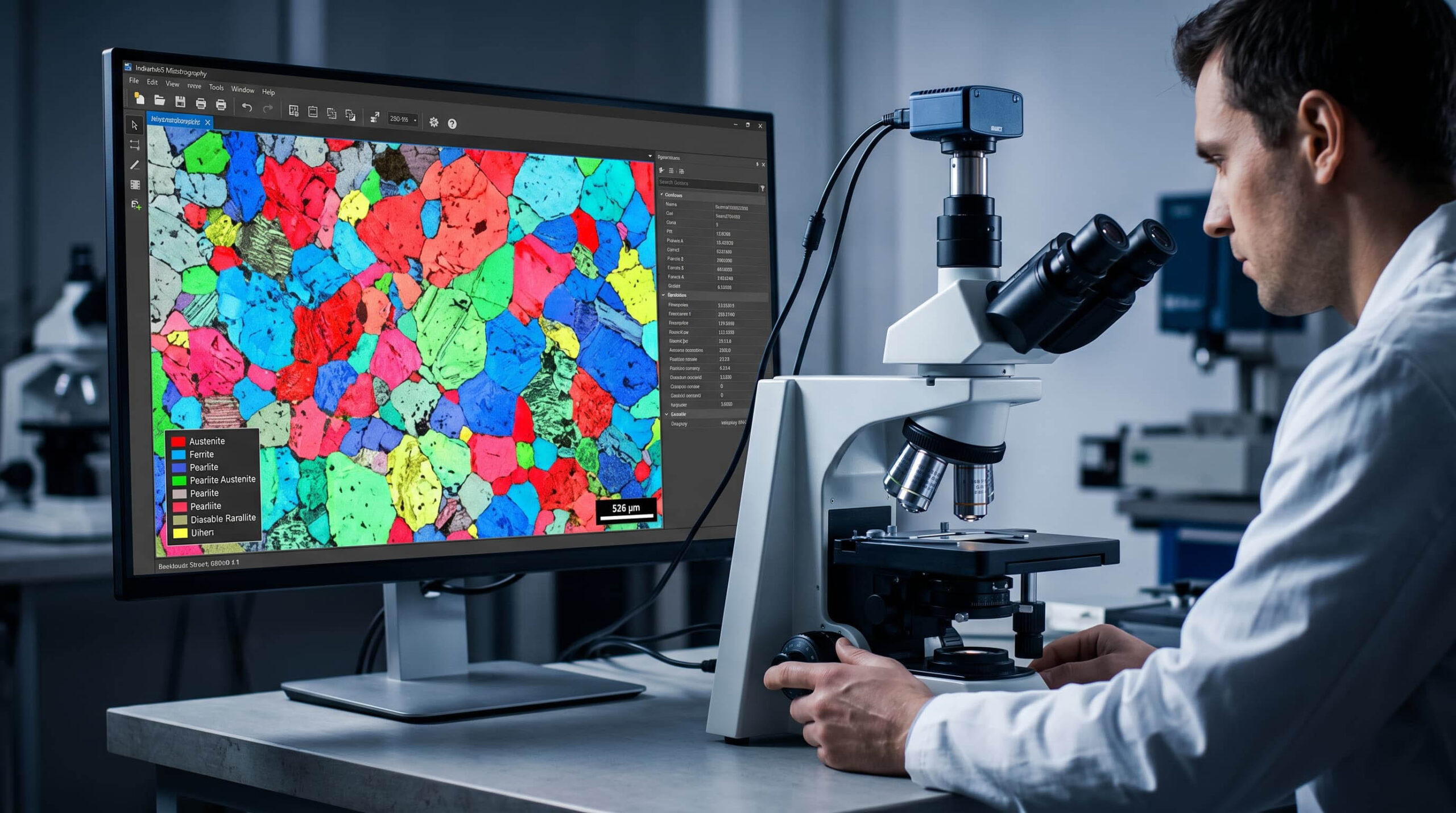
In the high-stakes environment of an industrial laboratory, the microscope is no longer just an optical instrument; it is a data hub. The days of lab technicians squinting through eyepieces for eight hours a day are rapidly fading, replaced by the “Screen Era” of microscopy. However, as many lab managers discover the hard way, not all digital viewers are created equal.
Choosing a professional microscope viewer software is the most critical decision you will make for your lab’s workflow in 2026. It is the difference between a system that merely “shows” a sample and one that “analyzes” it. Here is how to navigate the crowded market to find a solution that balances performance, compliance, and budget.
The “Basic Viewer” Trap
Many digital cameras come with a free, basic viewer. While these are fine for snapping a quick JPEG or showing a student a cool-looking crystal, they are dangerous in an industrial setting. A basic viewer lacks the mathematical rigor required for quality control. It doesn’t understand scale, it can’t compensate for lens distortion, and it certainly won’t help you during an audit.
A professional viewer is more than a window; it is a metrology tool. It must provide a live, high-frame-rate feed with zero “lag,” allowing for real-time focus and sample manipulation without the motion blur that plagues consumer-grade software.
1. The Compliance Factor: ASTM and ISO Integration
In industrial labs (especially in metallurgy), your viewer must be a guardian of standards. Your Google Search data shows a massive interest in ASTM E112 and ASTM E45. If your viewer software doesn’t have these standards built into its core, you are wasting hours on manual calculations.
The best professional software, like Microvision Suite, allows you to overlay ASTM charts directly onto the live feed or, better yet, use AI to perform the count automatically. When choosing software, ask: Does it generate an audit-ready report that cites the specific version of the standard used? If the answer is no, keep looking.
2. Hardware Agnosticism: Breaking the Brand Cage
One of the most expensive mistakes a lab can make is buying “closed-loop” software. Some manufacturers lock their viewer software so it only works with their specific (and overpriced) cameras.
In 2026, the trend is Hardware Agnosticism. A professional viewer should be able to “talk” to a Leica, Zeiss, Nikon, or a high-end industrial CMOS camera via universal drivers. This freedom allows you to upgrade your optics and your software at different times, ensuring you always have the best of both worlds without being held hostage by a single vendor’s pricing.
3. Visualization Beyond the Lens (EDF and Stitching)
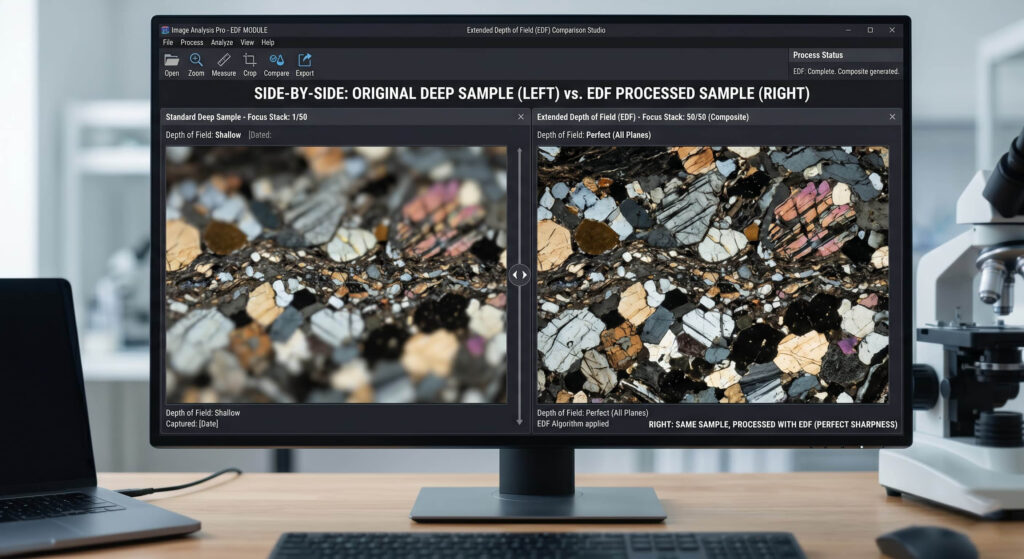
Industrial samples are rarely perfectly flat. If you are analyzing a fracture surface or a deep corrosion pit, the shallow depth of field of a high-magnification lens is your enemy.
A professional-grade viewer must include Extended Depth of Field (EDF). This feature allows the software to “stack” focus planes in real-time, delivering a single, crystal-sharp image where every peak and valley is in focus. Similarly, for large-scale weld inspections, image stitching (mosaicing) is essential to create a high-resolution “map” of the entire part while maintaining microscopic detail.
4. The AI “Assistant”: From Viewing to Knowing
The most significant shift in 2026 is the move from passive viewing to Active AI Analysis. A modern professional viewer doesn’t just display pixels; it interprets them.
Using Deep Learning, the software can identify grain boundaries, count inclusions, or measure coating thicknesses with a level of repeatability that humans simply cannot match. It removes the “subjectivity” of the observer. Whether the lab technician is tired on a Friday afternoon or fresh on a Monday morning, the AI viewer delivers the same, standardized result.
5. End-to-End Workflow: The 60-Second Report
Finally, look at the “exit strategy.” What happens after you see the image? In a professional industrial lab, the analysis isn’t finished until the report is signed.
The best viewer software automates this. It should capture the image, perform the AI analysis, apply the ASTM standard, and export a branded PDF report in under 60 seconds. If your current process involves saving images to a desktop and then manually copying data into a Word document, you aren’t just behind the times—you are losing money every single day.
Conclusion: The Digital Brain of Your Lab
Your microscope’s optics are its eyes, but the software is its brain. In 2026, investing in a high-performance, professional microscope viewer like Microvision is the fastest way to modernize your lab. It turns an observation tool into a precision metrology engine, ensuring that what you “see” is backed by data, compliant with standards, and ready for the most rigorous industrial audits.
Leave a Reply