
How Artificial Intelligence Is Transforming Microstructure Analysis
Vickers hardness testing has long been a cornerstone of metallography and materials science. For decades, laboratories have relied on manual indentation measurement under optical microscopes to determine material hardness. While the method itself is highly reliable, the workflow often depends on operator precision, manual diagonal marking, and time-consuming calculations.
Today, artificial intelligence is redefining this process.
AI-automated Vickers hardness testing introduces deep learning–based indentation detection, enabling faster, more objective, and highly repeatable hardness evaluation directly from digital microscope images.
What Is Vickers Hardness Testing?
The Vickers hardness test determines a material’s hardness by pressing a diamond pyramid indenter into the surface under a specific load. The two diagonals of the resulting indentation are measured, and the Vickers hardness value (HV) is calculated accordingly.
Traditional workflow typically includes:
- Optical microscope inspection
- Manual diagonal measurement
- Operator-dependent marking
- Hardness value calculation
While effective, this process can introduce variability between operators and laboratories.
The Shift Toward AI-Automated Hardness Testing
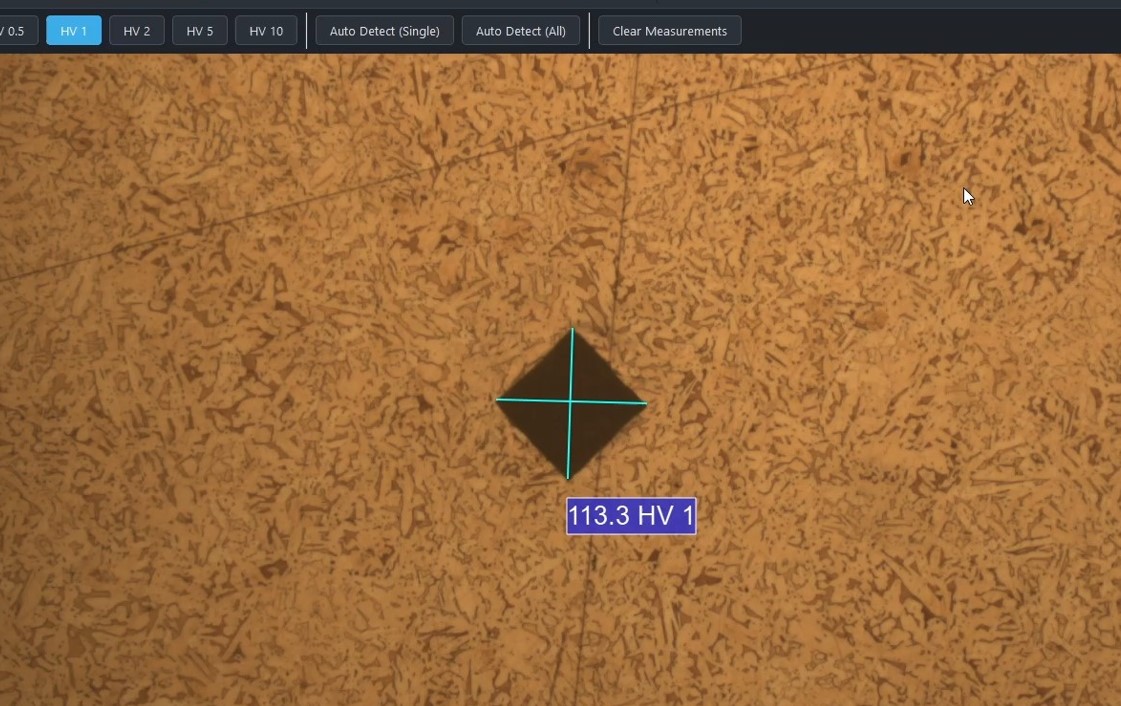
AI-automated Vickers hardness testing leverages deep learning models trained to detect indentation geometry directly from microscope images.
Instead of manually drawing diagonals, the system:
- Identifies the indentation automatically
- Detects its geometric boundaries
- Measures diagonals with pixel-level precision
- Calculates the hardness value instantly
This significantly reduces subjectivity and accelerates laboratory throughput.
How Deep Learning Improves Indentation Detection
Modern AI systems use object detection architectures such as YOLO (You Only Look Once) to identify visual features within images.
When trained specifically on metallographic datasets, these models learn to recognize:
- Vickers indentation edges
- Contrast variations in polished surfaces
- Surface irregularities
- Variations caused by etching or illumination
Unlike traditional threshold-based image processing, deep learning models do not rely solely on contrast segmentation. Instead, they learn structural patterns from real-world data, making them more robust across different sample conditions.
Benefits of AI-Automated Vickers Hardness Testing
1. Improved Repeatability
Manual diagonal selection can vary slightly between operators. AI-based measurement ensures consistent geometric interpretation across images and users.
2. Reduced Analysis Time
Automatic indentation detection eliminates manual marking, significantly speeding up hardness evaluation workflows.
3. Lower Operator Bias
AI reduces subjective interpretation and improves objectivity in materials testing environments.
4. Scalable Industrial Deployment
Automated systems are ideal for high-volume industrial quality control, where consistency and speed are critical.
5. Digital Traceability
AI-based metallography software allows digital storage of images, detected geometries, and calculated hardness values — supporting audit trails and documentation requirements.
Manual vs AI-Assisted Hardness Testing
It is important to emphasize that AI automation does not replace professional expertise — it enhances it.
Modern metallography software platforms allow both:
- Fully automatic indentation detection
- Manual diagonal measurement and verification
This dual approach gives laboratories flexibility. Operators can rely on AI for speed and repeatability while retaining manual control whenever verification or adjustment is required.
Applications in Industry and Research
AI-automated Vickers hardness testing is particularly valuable in:
- Industrial quality control laboratories
- Manufacturing process validation
- Heat treatment verification
- Academic materials science research
- Failure analysis investigations
By integrating AI into digital microscope software, laboratories can transform traditional metallography workflows into intelligent, data-driven processes.
Leave a Reply