
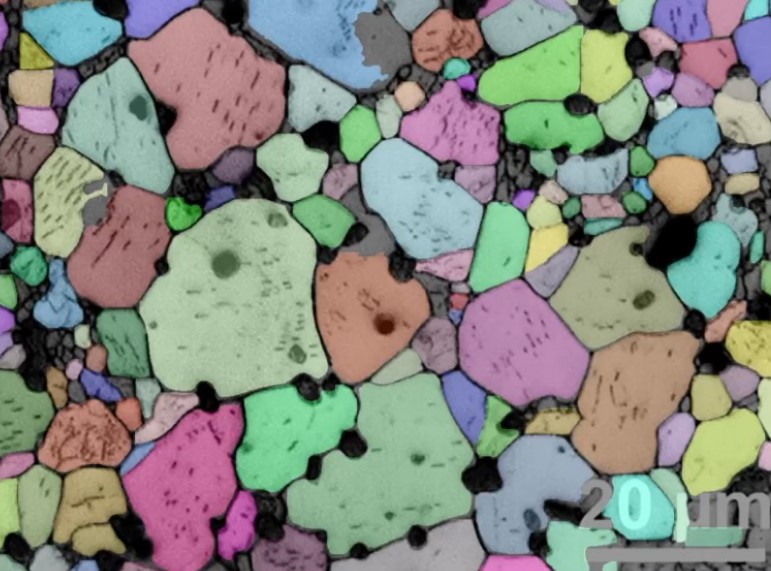
Grain size analysis plays a fundamental role in metallography and materials science. The size and distribution of grains directly influence mechanical properties such as strength, toughness, fatigue resistance, and ductility. For decades, laboratories have relied on manual or semi-automated methods to evaluate grain size according to ASTM E112.
Today, artificial intelligence is redefining how grain size analysis is performed.
AI-powered grain size analysis introduces deep learning–based automatic grain boundary detection, significantly improving speed, repeatability, and objectivity in microstructure evaluation.
Understanding ASTM E112 Grain Size Analysis
ASTM E112 is the standard test method for determining average grain size in metallic materials. It includes several approaches such as:
- Comparison methods
- Planimetric (Jeffries) method
- Intercept method
All of these techniques require accurate identification of grain boundaries within metallographic micrographs.
Traditionally, this process depends on:
- Proper sample preparation and etching
- Optical microscope imaging
- Manual tracing or threshold-based image segmentation
- Operator interpretation
While effective, these methods can be time-consuming and sensitive to variations in lighting, contrast, and sample preparation quality.
The Challenge of Traditional Grain Boundary Detection
Conventional image processing techniques typically rely on thresholding, edge detection filters, or contrast-based segmentation. These methods work well under controlled conditions but often struggle when:
- Grain boundaries have uneven contrast
- Etching quality varies
- Illumination is inconsistent
- Microstructures are complex
As a result, manual correction is frequently required, increasing analysis time and introducing operator-dependent variability.
This is where AI-powered metallography software offers a major advantage.
How AI Improves Grain Size Analysis
AI-powered grain size analysis uses deep learning models trained specifically on metallographic datasets. Instead of relying purely on pixel intensity differences, the model learns structural features that define grain boundaries.
Modern object detection architectures, such as YOLO (You Only Look Once), can be adapted for grain boundary recognition. Once trained, the AI model can:
- Automatically detect grain boundaries
- Adapt to varying contrast and etching conditions
- Recognize complex microstructural patterns
- Reduce noise-related segmentation errors
Because the system learns from real metallographic images, it becomes significantly more robust than traditional rule-based image processing.
Benefits of AI-Powered Grain Size Analysis (ASTM E112)
1. Increased Repeatability
AI-based grain boundary detection ensures consistent interpretation across samples and operators, reducing subjective variability.
2. Faster Workflow
Automatic grain detection dramatically reduces the time required for microstructure analysis, especially in high-volume laboratory environments.
3. Improved Objectivity
By minimizing manual intervention, AI enhances the objectivity of ASTM E112 grain size evaluation.
4. Scalability for Industrial Use
Industrial quality control laboratories benefit from automated grain size analysis that can be deployed across multiple workstations with consistent performance.
5. Digital Documentation
AI-driven systems allow image storage, boundary overlays, and calculated grain size results to be archived digitally, improving traceability and compliance.
AI Automation with Manual Control
It is important to note that AI-powered grain size analysis does not eliminate the need for expert validation. Modern metallography software platforms typically allow both:
- Fully automatic grain boundary detection
- Manual inspection and refinement
This hybrid workflow ensures that laboratories maintain full analytical control while benefiting from automation.
Applications Across Industry and Research
AI-powered ASTM E112 grain size analysis is valuable in:
- Heat treatment verification
- Process optimization
- Failure analysis
- Materials development
- Academic research
- Industrial quality assurance
As materials engineering continues to advance, rapid and reliable microstructure characterization becomes increasingly important.
The Future of Microstructure Analysis
Artificial intelligence is becoming an essential component of modern metallography software. From automated Vickers hardness testing to AI-based grain boundary detection, deep learning enables faster, more reliable, and more scalable material evaluation.
AI-powered grain size analysis according to ASTM E112 represents a significant step toward fully digital, intelligent metallography workflows.
Rather than replacing expertise, AI enhances it — providing tools that support engineers, researchers, and quality control professionals in achieving higher levels of precision and efficiency.
Leave a Reply