
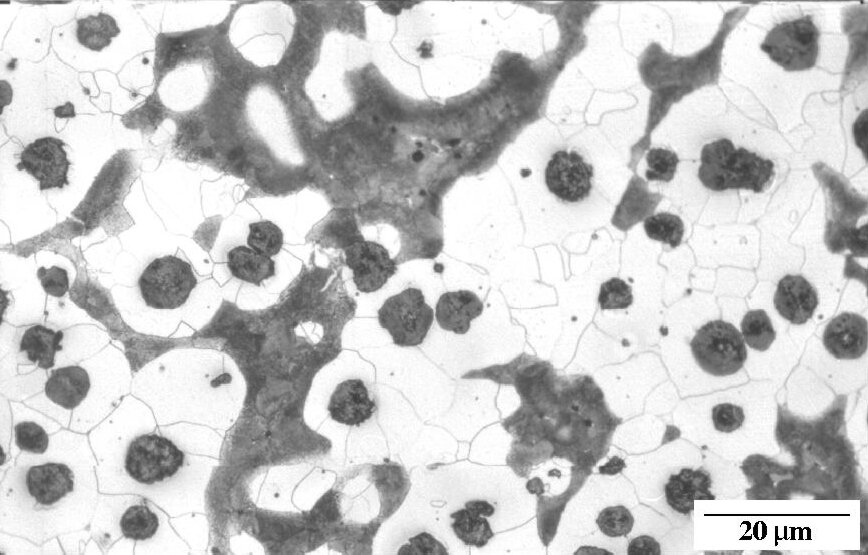
White cast iron is a type of cast iron known for its hard and brittle nature. Its unique microstructure distinguishes it from other cast irons and gives it distinct mechanical properties, making it suitable for specific industrial applications. Understanding the microstructure of white cast iron is crucial for metallurgists, engineers, and quality control professionals who aim to optimize its performance in industrial processes.
What is White Cast Iron?
White cast iron is a ferrous alloy that contains a high carbon content, typically between 2.5% and 3.5%, and silicon levels of 0.5–1.5%. Unlike gray cast iron, which has graphite flakes dispersed in its microstructure, white cast iron contains carbon primarily in the form of cementite (Fe₃C). This gives it a hard, white fracture surface when broken, hence the name “white cast iron.”
Its microstructure is predominantly composed of:
- Cementite (Fe₃C) – hard and brittle iron carbide
- Pearlitic matrix – a combination of ferrite and cementite in lamellar form
- Small regions of ferrite, depending on composition and cooling rate
Microstructure of White Cast Iron
The microstructure of white cast iron can vary depending on its chemical composition and cooling conditions during solidification. The main features include:
Cementite Network
Cementite forms a continuous or semi-continuous network throughout the material, providing extreme hardness. This network also makes the material brittle and prone to cracking under impact.
Pearlite
Pearlite appears as alternating layers of ferrite and cementite. It contributes slightly to toughness but is generally overshadowed by the brittleness of cementite.
Grain Structure
White cast iron typically has a fine-grained structure due to rapid cooling, which suppresses the formation of free graphite. Smaller grains increase hardness and wear resistance but further reduce ductility.
Factors Affecting Microstructure
Several factors influence the final microstructure of white cast iron:
- Chemical Composition – Higher carbon and silicon content promotes cementite formation.
- Cooling Rate – Rapid cooling favors white cast iron formation, while slower cooling can produce gray or mottled cast iron.
- Alloying Elements – Chromium, nickel, or molybdenum can modify microstructure, enhancing wear resistance or toughness.
- Heat Treatment – Tempering or annealing can alter the cementite network, reducing brittleness.
Mechanical Properties
Due to its unique microstructure, white cast iron exhibits:
- High hardness – typically 400–600 HB (Brinell Hardness)
- Excellent wear resistance – ideal for abrasive applications
- Low ductility and toughness – prone to cracking under impact
- Limited machinability – requires specialized tools for shaping
These properties make it suitable for specific industrial applications where hardness and wear resistance are more important than toughness.
Applications of White Cast Iron
White cast iron is widely used in industries that require extreme wear resistance. Common applications include:
- Grinding media – balls and liners in ball mills for ore processing
- Crusher components – jaws, rolls, and liners in mining equipment
- Abrasion-resistant plates – in cement and steel plants
- Pump components – for slurry handling in mineral processing
In each application, understanding and controlling the microstructure is critical to ensure optimal performance and longevity.
Metallographic Analysis of White Cast Iron
Metallographic analysis provides insights into the microstructure and quality of white cast iron. Standard procedures include:
- Sample Preparation – cutting, mounting, grinding, polishing, and etching
- Optical Microscopy – observing cementite networks, pearlite, and ferrite distribution
- Scanning Electron Microscopy (SEM) – detailed imaging of cementite and micro-cracks
- Image Analysis Software – quantitative measurement of phase fractions, grain size, and defect density
These analyses allow engineers to predict wear behavior, mechanical performance, and suitability for specific applications.
Challenges with White Cast Iron
- Brittleness – prone to fracture under impact loads
- Machining difficulty – high hardness requires specialized tools
- Heat treatment sensitivity – improper tempering can reduce wear resistance
- Microstructure control – rapid cooling must be carefully managed during casting
Despite these challenges, proper metallurgical control and design can maximize the benefits of white cast iron.
Conclusion
White cast iron is a unique material distinguished by its hard, cementite-rich microstructure. While its brittleness limits some applications, its high hardness and exceptional wear resistance make it invaluable in abrasive and high-wear environments. Through metallographic analysis, engineers can understand, predict, and optimize its performance for industrial uses.
As material science and digital analysis tools continue to advance, controlling the microstructure of white cast iron becomes more precise, enabling better performance, reliability, and efficiency in demanding applications.
Leave a Reply