
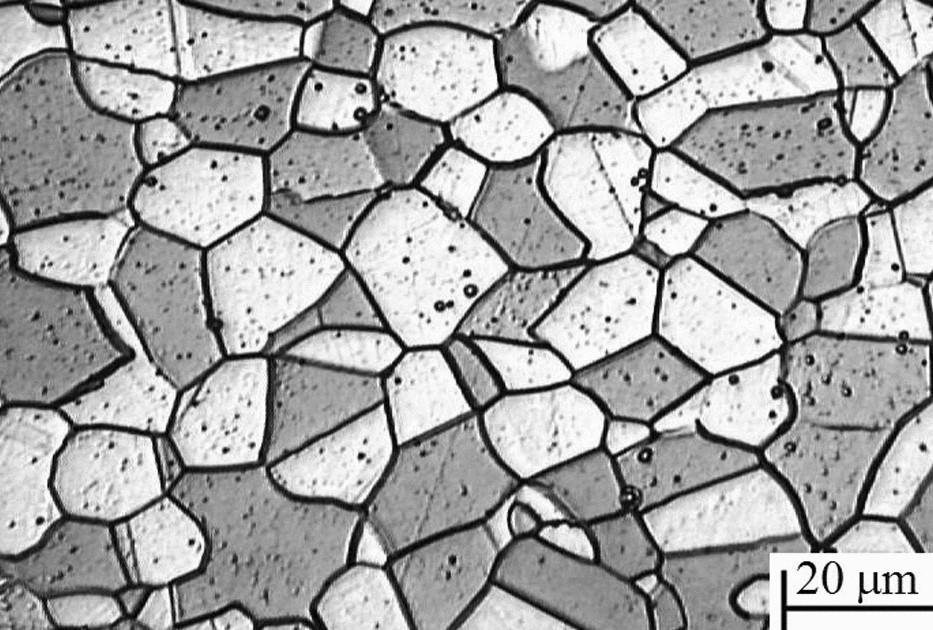
Grain size plays a critical role in determining the mechanical properties of metals, including strength, toughness, and fatigue resistance.
In this guide, you will learn:
– ASTM E112 grain size formula
– how to calculate grain size step-by-step
– ASTM grain size chart (G number table)
– real calculation examples
One of the most widely used standards for measuring grain size in metallography is ASTM E112. This standard provides several methods to quantify grain size in a consistent and repeatable way, making it essential for quality control, research, and industrial applications.
ASTM Grain Size Chart (G Number Table)
| G (ASTM Grain Size Number) | Grains per unit area (N) |
|---|---|
| 1 | 1 |
| 2 | 2 |
| 3 | 4 |
| 4 | 8 |
| 5 | 16 |
| 6 | 32 |
| 7 | 64 |
| 8 | 128 |
| 9 | 256 |
| 10 | 512 |
What is ASTM E112?
ASTM E112 is a standard test method that defines procedures for determining the average grain size of metallic materials. It applies primarily to materials with equiaxed grain structures and is commonly used in steel, aluminum, and other alloys.
Grain size is typically expressed as a grain size number (G), which is inversely related to the actual grain size. In simple terms, a higher G number means smaller grains, while a lower G number indicates larger grains.
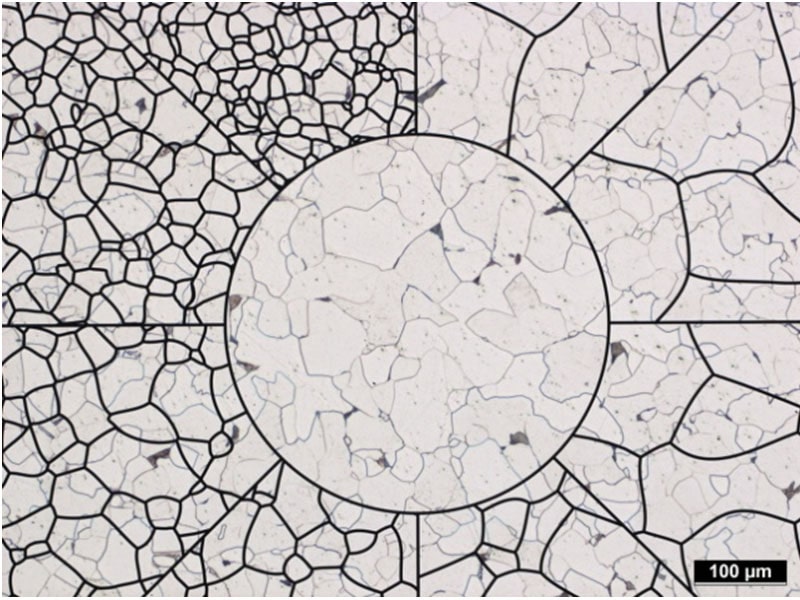
ASTM E112 Measurement Methods
ASTM E112 outlines several different techniques, each suited for specific types of microstructures and accuracy requirements.
1. Comparison Method
This is the fastest and most commonly used method.
- The microstructure image is visually compared with standardized grain size charts.
- The closest match determines the grain size number.
Advantages:
- Quick and simple
- No complex calculations required
Limitations:
- Subjective (depends on operator experience)
2. Planimetric Method (Jeffries Method)
This method involves counting the number of grains within a known area.
Steps:
- Draw a test circle or area on the micrograph.
- Count fully enclosed grains and estimate partially intersected grains.
- Calculate grain density.
This method is more accurate than the comparison method but also more time-consuming.
3. Intercept Method
The intercept method measures the number of grain boundary intersections along a test line.
Steps:
- Draw one or more straight lines across the image.
- Count how many times the line crosses grain boundaries.
- Use the average intercept length to calculate grain size.
Advantages:
- More objective
- Suitable for elongated grains
ASTM E112 Grain Size Formula
The ASTM grain size number is calculated using the formula:G=log2(N)+1
Where:
- G = ASTM grain size number
- N = number of grains per square inch at 100x magnification
This logarithmic relationship allows a wide range of grain sizes to be expressed in a standardized way.
How to Calculate Grain Size (Step-by-Step)
- Capture microstructure image
- Count grains / intercepts
- Calculate NA (grains per area)
- Apply ASTM formula
- Get G number
Practical Example
Let’s say you analyze a microstructure at 100x magnification and count 64 grains per square inch.G=log2(64)+1=6+1=7
So, the material has a grain size number of G = 7, indicating relatively fine grains.
Why Grain Size Matters
Grain size directly influences material properties:
- Smaller grains → higher strength (Hall-Petch relationship)
- Larger grains → better ductility and creep resistance
In industries such as aerospace, automotive, and energy, controlling grain size is essential for ensuring performance and safety.
Applications in Industry
ASTM E112 is widely used in:
- Quality control in steel production
- Failure analysis
- Heat treatment validation
- Research and development
It ensures that materials meet required specifications and behave predictably under stress.
FAQ
What is ASTM E112 used for?
ASTM E112 is used to determine the average grain size of metallic materials. It provides standardized methods—such as comparison, planimetric, and intercept techniques—to measure grain structure in metals. This is important for evaluating mechanical properties like strength, toughness, and fatigue resistance.
How is grain size calculated?
Grain size is calculated by counting the number of grains within a defined area and applying the ASTM E112 formula. The most common approach uses:
- counting grains or intercepts from a microstructure image
- converting the result into grains per unit area (N)
- calculating the ASTM grain size number (G) using a logarithmic formula
This ensures consistent and comparable results across different materials.
What is ASTM grain size number?
The ASTM grain size number (G) is a numerical value that represents the average size of grains in a material. A higher G number means finer grains, while a lower G number indicates coarser grains. Each increase in G approximately doubles the number of grains per unit area.
What is grain size chart?
A grain size chart is a reference table that shows the relationship between the ASTM grain size number (G) and the number of grains per unit area. It is used as a quick way to estimate or verify grain size without performing full calculations, especially in comparison methods.
Conclusion
ASTM E112 provides a reliable framework for measuring grain size using multiple methods, from quick visual comparison to precise quantitative techniques. Whether you are performing routine inspections or advanced materials research, understanding and applying these methods is crucial.
As metallography continues to evolve, traditional ASTM methods remain the foundation for accurate microstructural analysis—often complemented by modern digital and AI-based tools.


Leave a Reply