
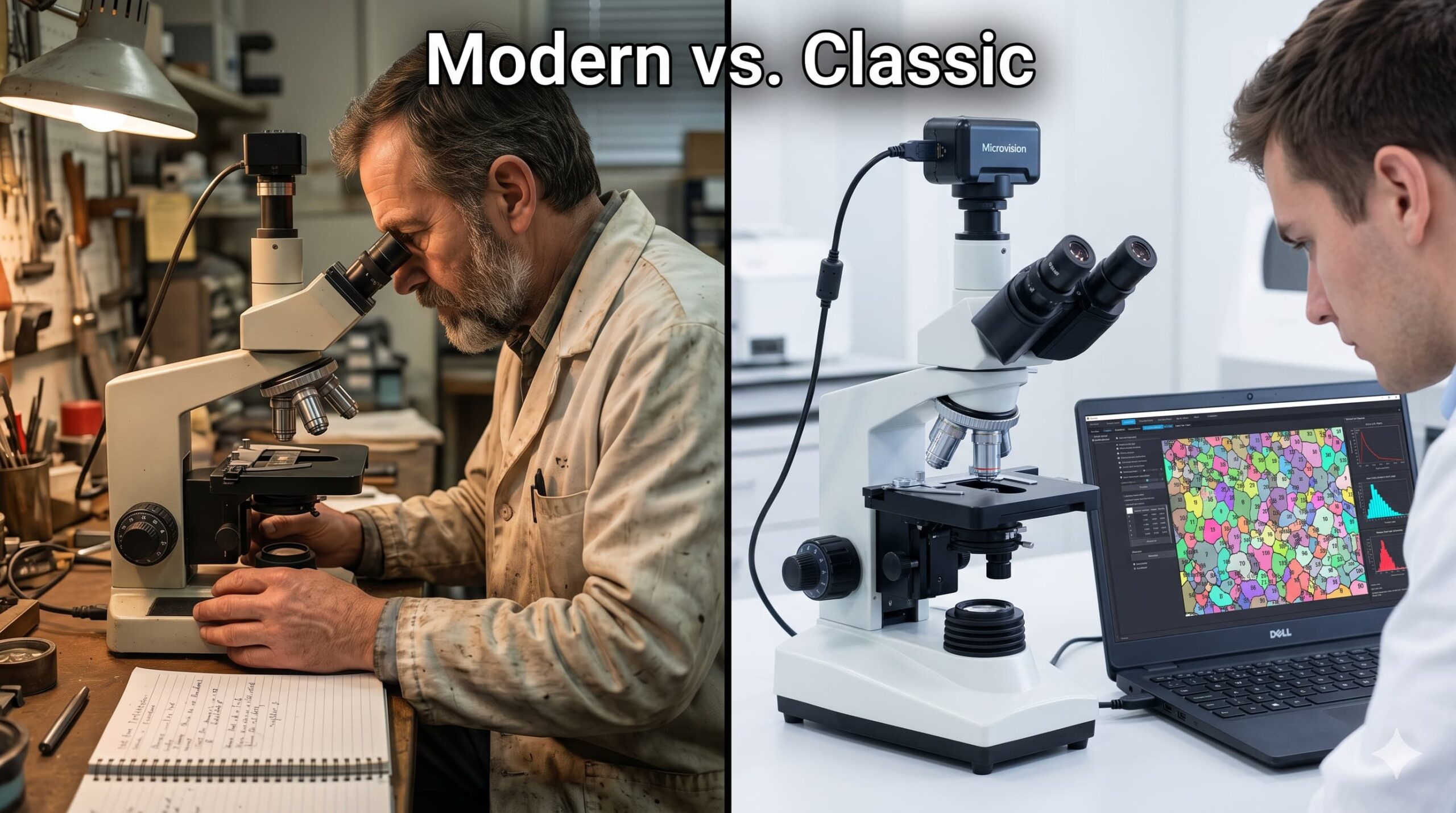
In many metallurgy and materials science labs, there is a “sleeping giant”: a 15-year-old upright or inverted microscope. Its chassis is heavy, its stage is smooth, and its optics—those high-quality objective lenses—are still as sharp as the day they were unboxed. However, it sits underused because the imaging process is stuck in the past. Researchers are still squinting through eyepieces, manually counting grains, and spending hours formatting reports in Excel.
In 2026, the bottleneck isn’t the glass; it’s the data. You don’t need to spend $60,000 on a brand-new, proprietary digital system to get modern results. By performing a “digital brain transplant” with AI-driven software, you can turn that old analog tool into a high-speed, automated powerhouse.
The Optics Myth: Why Your Old Glass is Still Good
A common misconception in the industry is that a “digital microscope” requires an entirely new hardware purchase. In reality, light hasn’t changed in a century. A high-quality objective lens from 2005 often outperforms a budget “all-in-one” digital camera lens from today.
The hardware that actually ages is the sensor and the processing engine. By adding a high-resolution C-mount CMOS camera to your existing microscope and pairing it with a modern analysis suite, you are effectively leapfrogging the technology found in many closed, proprietary systems.
Step 1: The Camera (The Bridge to Digital)
The first step in the transformation is the hardware bridge. A modern industrial camera can be attached to almost any microscope’s photoport. This allows you to bypass the eyepieces and feed a live, high-frame-rate signal directly into your computer. This immediately solves the problem of operator fatigue and subjective observation.
Step 2: AI-Driven Software (The Real Game Changer)
This is where the true power resides. Traditional microscope software relies on simple “thresholding”—finding dark lines on a light background. But real samples are messy. They have scratches, uneven etching, and artifacts that lead to incorrect data.
AI-driven software, such as Microvision Suite, uses Deep Learning to understand the context of your microstructure.
- Intelligent Segmentation: Instead of just looking for “dark pixels,” the AI recognizes the pattern of a grain boundary, even if the etch is faint.
- Artifact Rejection: It can automatically “ignore” polishing scratches or dust particles that would normally ruin a manual count.
- Speed: What takes a human 15 minutes to count manually can be analyzed by AI in less than 10 seconds with 99% repeatability.
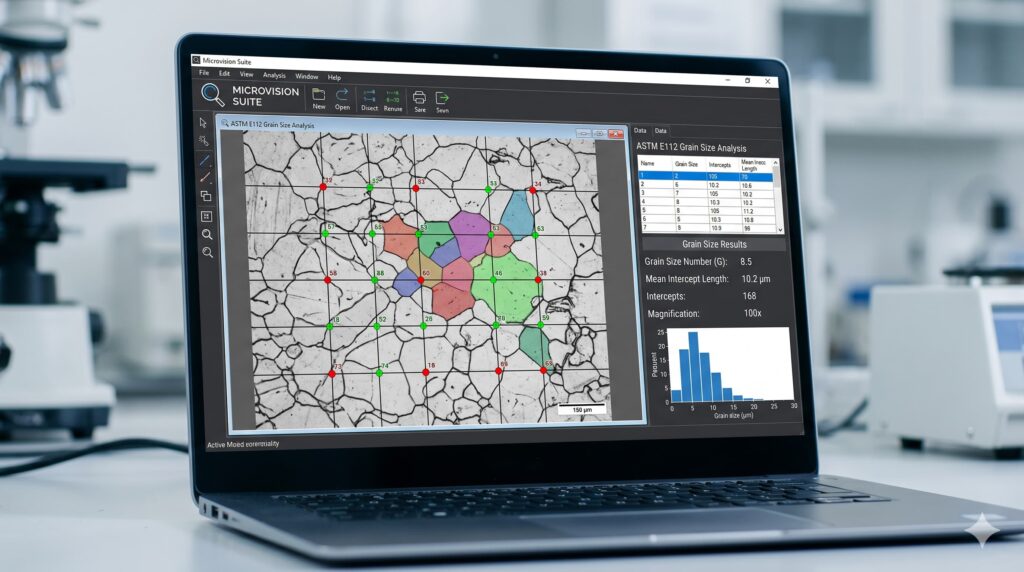
Step 3: Automating ASTM Compliance
One of the most valuable features of upgrading to a digital powerhouse is automated compliance. Your Search Console data shows a high interest in ASTM E112.
In a manual lab, achieving E112 compliance involves tedious intercept counting or chart comparisons. With a software upgrade:
- The system automatically overlays the intercept lines.
- It calculates the average grain size (G number) instantly.
- It ensures that every analysis follows the same mathematical rigor, removing the operator-to-operator variation that plagues traditional labs.
Step 4: The Instant Report
The final “powerhouse” feature is the elimination of the reporting bottleneck. If your lab is currently taking pictures, saving them to a USB drive, and then manually typing data into a Word document, you are losing money every hour.
Modern AI software generates an audit-ready, branded PDF report the moment you click “Analyze.” It includes your micrographs, histograms, data tables, and a clear “Pass/Fail” status based on your project’s specifications.
Conclusion: ROI that Makes Sense
Upgrading your existing microscope with a suite like Microvision is not just about cool technology; it’s about Return on Investment (ROI). For roughly 10-20% of the cost of a new system, you get:
- AI accuracy that eliminates human error.
- ASTM compliance that is audit-ready at any moment.
- 80% reduction in time spent per sample.
Don’t let your high-quality optics gather dust. Give them the digital brain they deserve and turn your “old” microscope into the most efficient tool in your lab.
Leave a Reply