
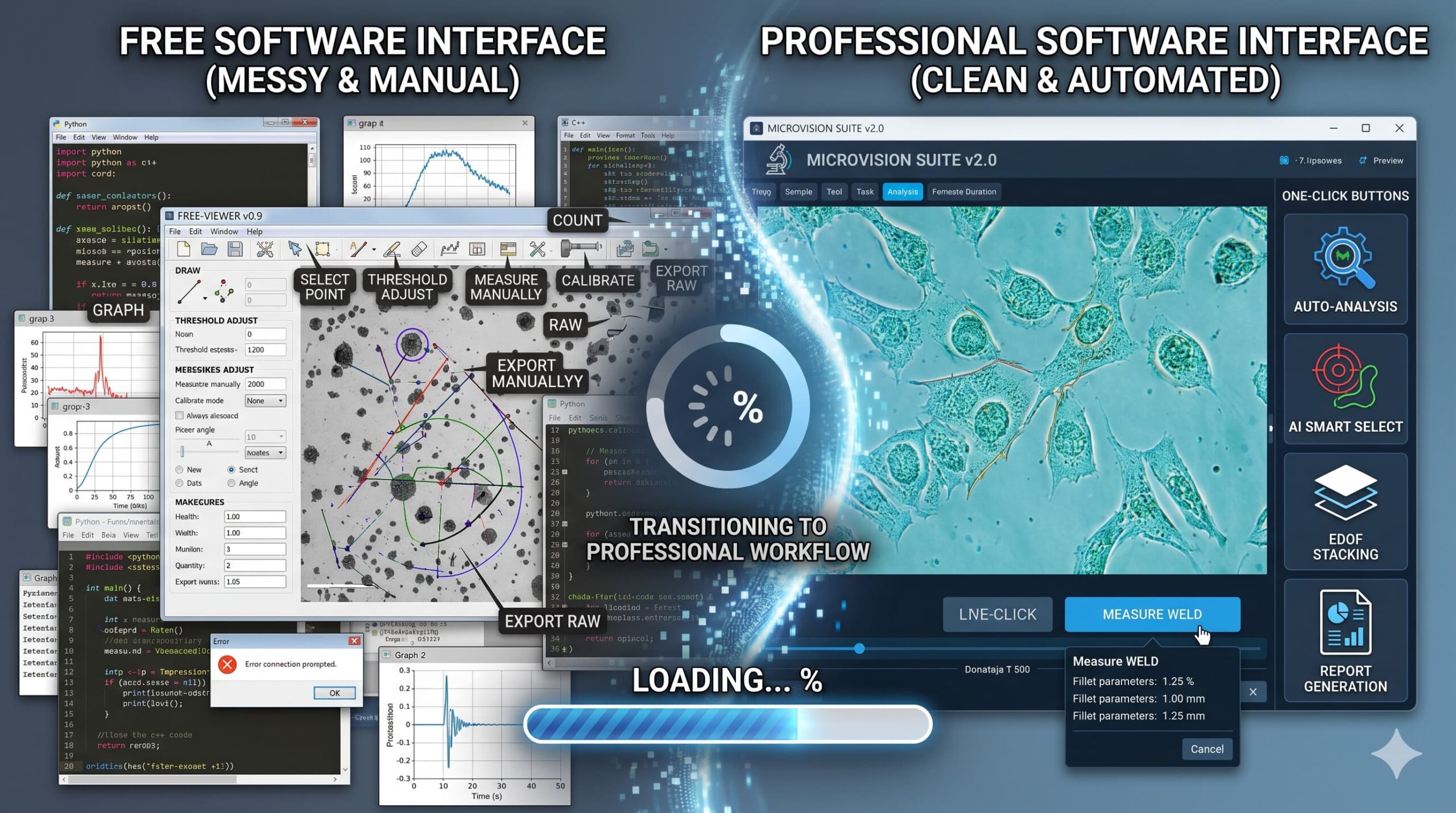
In every laboratory’s journey, there is a “honeymoon phase” with free software. Perhaps it started with ImageJ, Fiji, or a basic capture utility that came with a budget CMOS camera. For simple image snapping or academic tinkering, these tools are fantastic. They are the Swiss Army knives of the microscopy world—versatile, open-source, and, most importantly, cost nothing.
But as your lab grows, a quiet frustration begins to set in. You realize you are spending more time “cleaning up” images and manually drawing lines than actually analyzing materials. In 2026, the question isn’t just whether you can do the job for free, but at what cost to your productivity.
Here is how to know if your “free” software is actually costing you a fortune and when it’s time to move to a professional suite like Microvision.
The Hidden Cost of “Free”
The biggest misconception in metallography is that free software saves money. In reality, free software trades your time for its lack of a price tag.
If a highly-trained engineer spends 30 minutes manually counting grains or measuring coating thickness in a free tool—a task that a professional AI-driven software could do in 10 seconds—that “free” tool just cost the company a significant amount in billable hours. Over a year, those lost minutes accumulate into weeks of wasted salary.
The 3 “Hard Limits” You Eventually Hit
1. The Compliance Gap (ASTM/ISO)
Free software is rarely built with industrial standards like ASTM E112 or ISO 643 in mind. While you can manually perform an intercept count in ImageJ, you have to build the workflow yourself. In an audit, explaining a custom, manual workflow is a nightmare. Professional software has these standards “baked in,” providing a validated, repeatable, and audit-ready result with every click.
2. The “Struggle” with Automation
Free tools are usually “dumb.” They look at pixels but don’t understand the material. If your sample has a scratch or uneven etching, a free tool will count it as a grain boundary. You then spend the next 10 minutes manually deleting “ghost” data. Professional software in 2026 uses Deep Learning to ignore artifacts and focus only on the true microstructure.
3. The Reporting Bottleneck
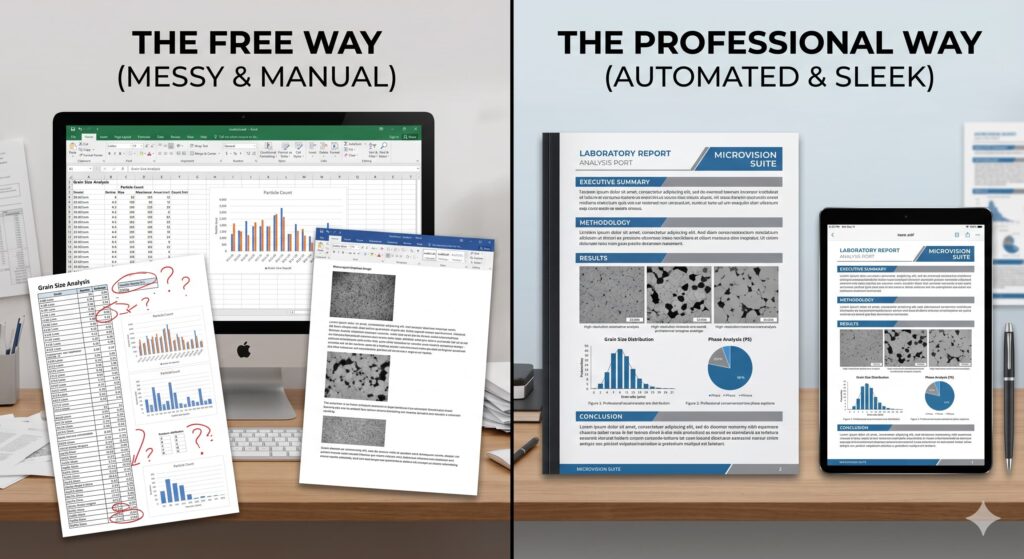
This is where free software truly fails. Once the analysis is done, you still have to copy the data into Excel, paste the image into Word, format the tables, and export a PDF. A professional suite automates this entire chain. The moment the analysis is done, the report is finished.
5 Signs It’s Time to Upgrade
If you recognize more than two of these signs in your daily lab life, you are ready for a professional upgrade:
- You dread audits: If the thought of showing an auditor your manual measurement process makes you nervous, you need the security of standardized software.
- High Throughput: Your sample volume has increased, and you are staying late just to finish “image processing.”
- Human Error is Creeping In: Different technicians are getting different results on the same sample because the process is too subjective.
- Hardware Frustration: Your free software doesn’t recognize your new high-resolution camera or can’t control your motorized stage.
- The “Expert” Left: Your lab relied on one person who knew how to “code” the free software, and now that they are gone, nobody knows how to use it.
The Professional Leap: Why Microvision?
Upgrading to a professional suite like Microvision doesn’t just give you more buttons; it gives you a validated workflow.
In 2026, the transition from free to professional is easier than ever. You don’t need to buy a new microscope. Modern professional software is designed to be a “digital brain” for your existing hardware. It brings AI-powered grain sizing, automated phase quantification, and instant reporting to the optics you already own.
Conclusion: Value vs. Price
Free software is an excellent starting point, but it was never designed to be a finish line for a professional industrial laboratory. When your lab’s reputation relies on the accuracy of your data and the speed of your delivery, “good enough” isn’t enough.
Upgrading to professional microscope software is an investment in your lab’s future. It turns your microscope from a simple magnifying glass into a high-speed data engine.
Leave a Reply