
In the precise world of metallography, preparing a sample of carbon steel for microscopic evaluation is only half the battle. You can cut the specimen perfectly, mount it in high-grade epoxy, and polish it down to a flawless 1-micron diamond finish. Yet, if you place that meticulously polished, mirror-like surface under a metallurgical microscope, you will see absolutely nothing.
To reveal the underlying crystalline structure—the phases, the grain sizes, and the thermal history of the metal—you must introduce a controlled chemical corrosion process known as etching. For carbon and low-alloy steels, the vast majority of laboratories rely on two legendary chemical solutions: Nital and Picral.
While novice technicians often use them interchangeably, assuming both are just “acid for steel,” making the wrong choice will completely obscure the critical data you are trying to capture. Understanding the distinct chemical mechanisms of Nital versus Picral is the difference between an accurate failure analysis and a worthless report. In this comprehensive guide, we will break down exactly how these two etchants work, what microstructural features they reveal, and how to choose the right one for your specific carbon steel application.
The Chemistry of Etching: Why Do We Need It?
Before diving into the specific reagents, it is vital to understand what etching actually does. When a polished metal surface is exposed to an etchant, the chemical does not dissolve the metal uniformly. Instead, it relies on selective dissolution.
Microstructural features with higher energy—such as grain boundaries, impurities, and the interfaces between different metallurgical phases—are attacked and dissolved much faster than the center of the grains. This microscopic unevenness creates microscopic shadows and variations in light reflectivity when viewed under an optical microscope, generating the visual contrast we recognize as a “microstructure.”
Deep Dive: Nital Etchant
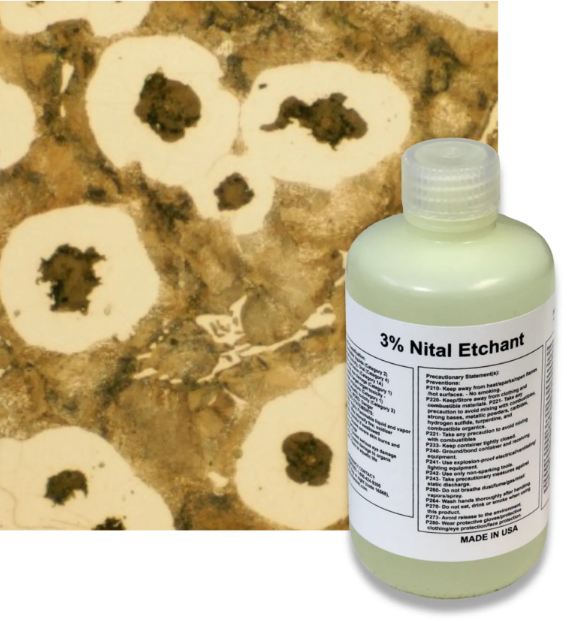
Nital is by far the most ubiquitous etchant in any metallurgical laboratory. Its name is a portmanteau of its two ingredients: Nitric acid and alcohol (usually ethanol or methanol). The standard concentration ranges from 1% to 5% nitric acid.
How Nital Works
Nital is primarily a grain boundary revealer for single-phase microstructures. It aggressively attacks the high-energy areas where different crystals meet. When applied to plain carbon steels, Nital actively dissolves the ferrite (pure iron) grain boundaries, making them appear as dark, distinct lines under the microscope.
Best Applications for Nital
- Low-Carbon Steels: Nital is the absolute standard for revealing the ferrite grain boundaries in low-carbon and mild steels. If you need to measure the grain size according to ASTM E112 standard practices, Nital is your go-to etchant.
- Martensitic Structures: When examining quenched or tempered steels, Nital does an excellent job of darkening martensite, allowing technicians to differentiate it from retained austenite (which remains white and unetched).
- Weld Evaluations: For general macro and micro-examinations of weldments to identify the Heat-Affected Zone (HAZ), a stronger Nital solution (typically 5% to 10%) provides excellent, rapid contrast.
The Drawbacks of Nital
Nital’s aggressive nature is its biggest flaw. When examining higher-carbon steels containing delicate structures like fine pearlite (alternating layers of ferrite and cementite), Nital tends to over-etch. It attacks the ferrite between the cementite layers so aggressively that the delicate lamellar structure collapses or becomes blurred, resulting in a dark, unresolved smudge rather than clear, measurable lines.
Deep Dive: Picral Etchant
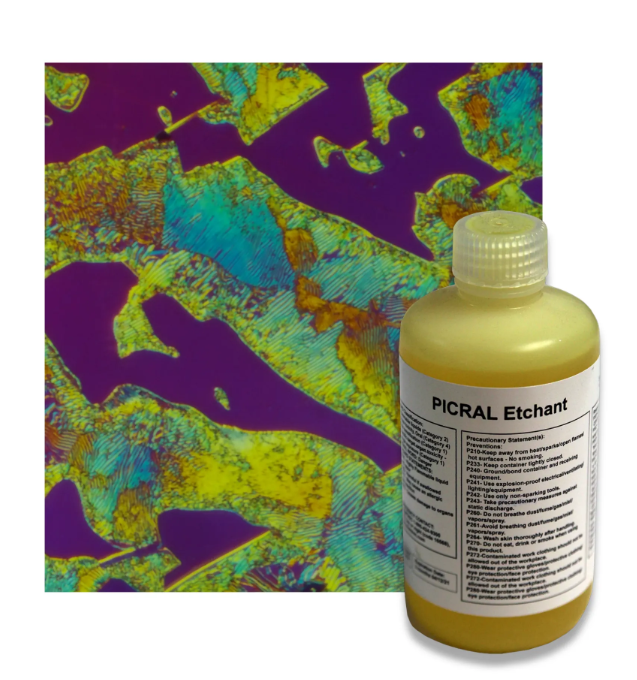
Picral is the sophisticated, highly targeted counterpart to Nital. It consists of Picric acid dissolved in alcohol, universally mixed at a 4% concentration.
How Picral Works
Unlike Nital, Picral does not attack ferrite grain boundaries. You could leave a pure ferrite sample in Picral for ten minutes, and the grain boundaries would remain nearly invisible. Instead, Picral is highly selective: it specifically attacks the interfaces between ferrite and cementite (iron carbide).
Best Applications for Picral
- Resolving Fine Pearlite: If you are analyzing medium to high-carbon steels and need to clearly see the lamellar spacing of pearlite, Picral is mandatory. It delicately outlines the cementite plates without destroying the surrounding ferrite, providing crisp, high-resolution images.
- Spheroidized Carbides: When steel is annealed to improve machinability, the rigid pearlite plates break down into tiny spheres of carbide (spheroidite). Picral beautifully highlights these individual spheres, allowing software to easily measure their size and distribution.
- Tool Steels: Highly alloyed tool steels contain various complex carbides. Picral reveals these carbides with exceptional clarity, making it much easier to detect carbide networking or banding that could lead to premature tool failure.
The Drawbacks (and Dangers) of Picral
Picral acts much slower than Nital; an etch that takes 5 seconds in Nital might take 30 to 60 seconds in Picral. Furthermore, dry picric acid is highly unstable and explosive. Laboratories must strictly manage their inventory, ensuring the crystallized picric acid powder remains hydrated at all times to prevent severe safety hazards. Because of these storage restrictions, many modern labs avoid it unless absolutely necessary, which is a disservice to high-quality metallography.
The Head-to-Head Comparison
To summarize the decision-making process in the lab, consider these general rules:
- Use Nital when you need to see the grain size of the ferrite or evaluate the general structure of low-carbon steel.
- Use Picral when you need to see the exact shape, size, and distribution of carbides, or when you need to resolve the fine details of pearlite in high-carbon steel.
In many rigorous failure analysis scenarios, metallurgists will actually use both. They will polish the sample, etch it with Picral to photograph the carbides, then repolish the sample on the final finishing wheel, and etch it again with Nital to reveal the ferrite grain boundaries.
Bridging the Gap: Etching and Digital Analysis
Perfecting your etching technique is only the first step in modern material analysis. Once you have successfully revealed the delicate pearlite with Picral or the grain boundaries with Nital, you must capture that data accurately.
This is where understanding the physical scale of your sample becomes paramount. If you are uncertain about how the microscopic views of these etched grains correlate with the larger physical properties of your forged or cast components, we highly recommend reading our guide on Macrostructure vs. Microstructure: Understanding the Scale of Material Analysis.
Furthermore, when photographing delicate microstructures etched with Picral at 1000x magnification, the optical depth of field becomes frustratingly shallow. Utilizing advanced software solutions designed to computationally extend your focal depth will ensure that every single carbide sphere and lamellar plate remains in razor-sharp focus across the entire digital frame, making automated software analysis faster and infinitely more accurate.
Ultimately, the synergy of a perfectly chosen chemical etchant and advanced digital imaging software is the hallmark of a world-class metallurgical laboratory.
Leave a Reply