
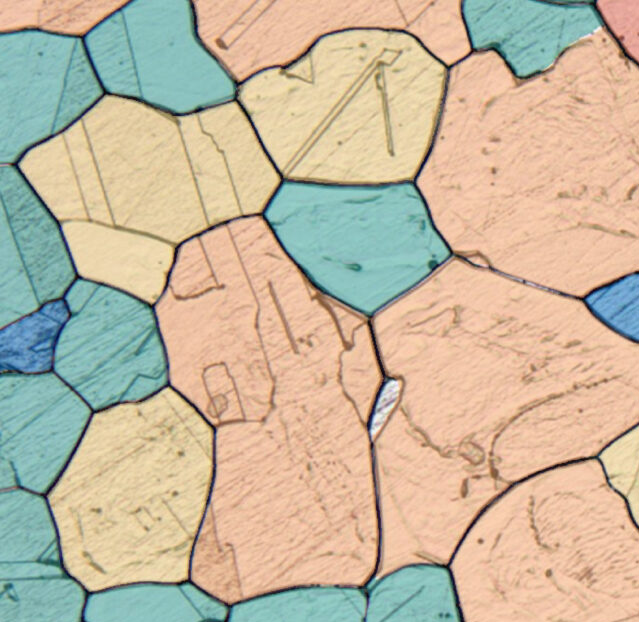
In the world of metallurgy, grain size is more than just a microscopic feature—it is a fundamental predictor of a material’s mechanical properties. From yield strength to toughness, the crystalline structure of a metal dictates how it will perform under stress. For decades, the ASTM E112 standard has been the “bible” for determining average grain size, but the methods used to achieve these measurements have undergone a radical transformation.
Today, laboratories face a critical choice: stick with traditional manual techniques or transition to automatic grain size measurement software. In this guide, we will dive into the differences, the challenges of compliance, and why the digital shift is becoming unavoidable for modern quality control.
The Foundation: Understanding ASTM E112
The ASTM E112 standard describes several manual procedures for estimating grain size, primarily the Comparison Procedure, the Planimetric (Jeffries) Procedure, and the Intercept Procedure.
Traditionally, a metallurgist would look through a microscope eyepiece and compare the observed structure against a set of standard wall charts. While this method served the industry for a century, it relies heavily on the “trained eye.” This introduces a significant level of subjectivity; two different technicians might look at the same sample and provide two different grain size numbers (G).
The Manual Struggle: Human Fatigue and Error
Manual grain size estimation is a time-consuming and mentally taxing process. When a lab technician has to analyze dozens of samples a day, “eyeball fatigue” sets in.
- Subjectivity: Manual methods are prone to bias. A technician might subconsciously “round up” or ignore certain boundary areas.
- Inconsistency: Results can vary between different shifts or different laboratories.
- Speed: Manual intercept counting can take several minutes per field of view, significantly slowing down the production pipeline.
The Rise of Automatic Grain Size Measurement
Modern software has changed the landscape by utilizing advanced image processing algorithms to detect grain boundaries. Automatic grain size measurement eliminates the guesswork by applying the same mathematical rigov to every single pixel of the digital micrograph.
How Software Does It
After a sample has been properly prepared and etched (using techniques like Nital vs Picral etchant), the software captures a high-resolution image. It then:
- Thresholds the image: Separating the dark grain boundaries from the lighter grains.
- Reconstructs boundaries: AI-driven tools can often “close” incomplete boundaries that were poorly etched.
- Calculates G-Value: Instantly applying the ASTM E112 formulas to provide a precise, repeatable result.
Software vs. Manual: A Head-to-Head Comparison
| Feature | Manual ASTM E112 Methods | Automatic Grain Size Measurement |
| Accuracy | High (but subjective) | Exceptionally High (objective) |
| Speed | 5–10 minutes per sample | < 5 seconds per sample |
| Repeatability | Low (varies by user) | Perfect (same result every time) |
| Data Storage | Manual logs/spreadsheets | Automated digital database & PDF reports |
| Cost | Low initial / High labor cost | High initial / Low labor cost |
Challenges in Automation
While software is superior in speed, it is only as good as the sample preparation. If the sample has preparation errors like scratches or relief, the software might misinterpret a scratch as a grain boundary. This is why a clean etch and a mirror-like polish remain the foundation of any automated lab.
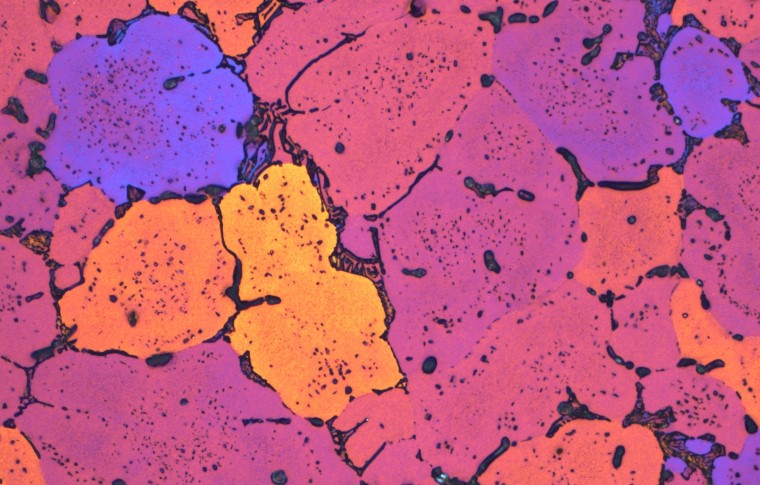
Furthermore, complex microstructures—such as those found in stainless steel—can sometimes confuse basic thresholding algorithms. However, the latest generation of AI-powered software can now distinguish between twins, inclusions, and true grain boundaries with nearly 100% accuracy.
Why Your Lab Needs to Upgrade
The transition to automatic grain size measurement isn’t just about speed; it’s about liability and audit trails. In industries like aerospace and automotive, having a digital record of the exact measurement process—complete with the original image and the boundary detection overlay—provides an unshakeable level of traceability that manual methods simply cannot match.
By integrating automated software, labs can free up their most skilled personnel for complex failure analysis rather than repetitive counting tasks.
Conclusion
ASTM E112 remains the gold standard, but the way we reach that standard is evolving. Manual methods provide a great pedagogical foundation, but for a high-output industrial environment, automatic grain size measurement is the clear winner. It offers the precision, speed, and objectivity required in an era of zero-defect manufacturing.
Leave a Reply