
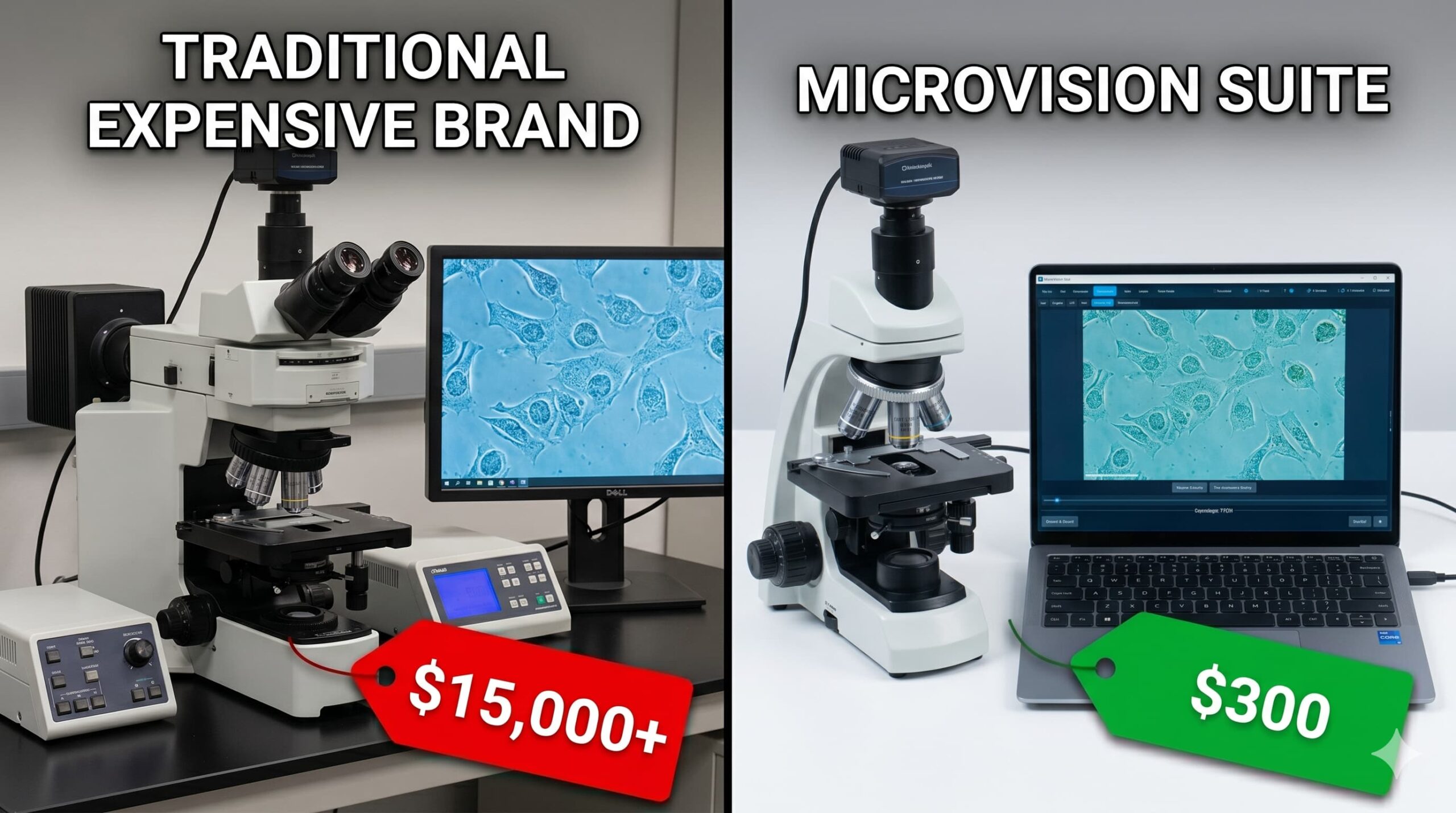
For years, the world of professional microscopy followed a frustrating “printer ink” business model. You would invest tens of thousands of dollars in a high-end microscope from a major brand, only to find that the software required to actually analyze your samples cost almost as much as the hardware. Even worse, that software was often “locked” to that specific brand, forcing you into a proprietary ecosystem that felt more like a cage than a laboratory.
As we move through 2026, that cage has been broken. A new generation of brand-agnostic, high-performance microscope software has emerged, proving that “professional” doesn’t have to mean “overpriced.” If you are looking to upgrade your lab’s capabilities without draining your entire annual budget, here is why 2026 is the year of the affordable software revolution.
The Myth of “Expensive is Better”
In the past, high prices were justified by the complexity of image analysis algorithms. Calculating grain size according to ASTM E112 or quantifying phases in a multi-component alloy required heavy-duty coding that only a few companies could provide.
Today, the democratization of Deep Learning (AI) has leveled the playing field. Modern, affordable suites like Microvision use the same—and often superior—AI architectures as the legacy giants. The result? You are no longer paying for the R&D of the 1990s; you are paying for efficient, modern code that runs faster and costs less.
What Defines “Professional” in 2026?
When we talk about “affordable” software, we aren’t talking about free hobbyist tools or basic capture apps. To be considered professional in a 2026 industrial or research environment, the software must hit three critical marks:
1. Universal Compatibility (Brand Agnosticism)
A professional software in 2026 should not care if your camera is a Leica, a Zeiss, or a high-end industrial CMOS from a specialized manufacturer. The best affordable solutions today use universal drivers (like TWAIN or DirectShow) to interface with any hardware. This allows you to upgrade your software and your camera independently, saving thousands in “system bundles.”
2. Full ASTM and ISO Compliance
If your software can’t generate a report that passes an audit, it isn’t professional. Affordable leaders in the market now include built-in modules for:
- ASTM E112 (Grain Size Analysis)
- ASTM E45 (Inclusion Rating)
- ISO 643 (Steels — Micrographic determination of the apparent grain size) Accuracy is a mathematical standard, not a brand privilege.
3. Automated Reporting
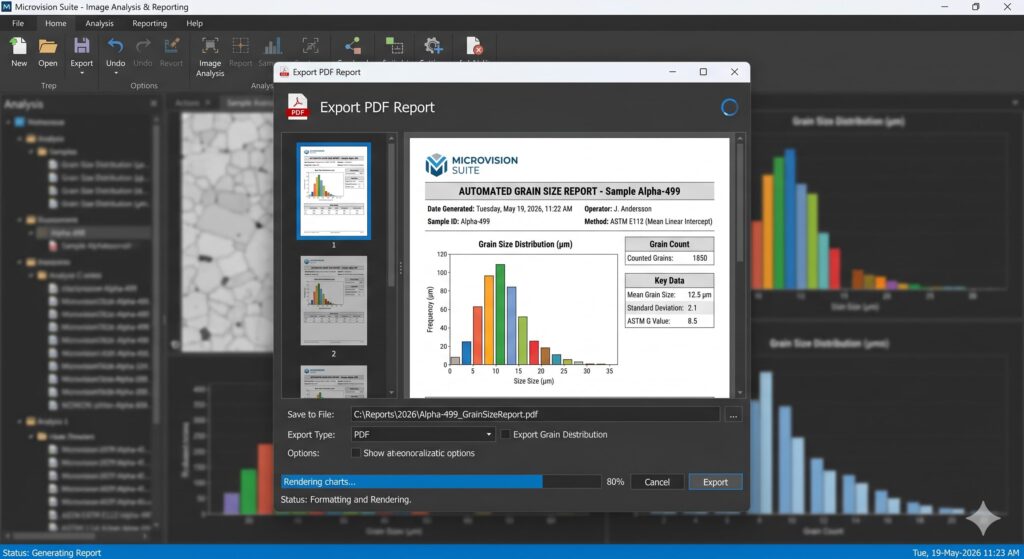
The most expensive thing in a lab is time. Professional software must automate the “paperwork.” The ability to click a button and have a PDF report—complete with micrographs, data tables, and your company logo—is no longer a luxury feature; it is a baseline requirement for productivity.
Why Microvision Suite is Leading the “Low Budget” Revolution
Among the available options in 2026, the Microvision Suite has become a standout for labs focused on ROI (Return on Investment). It bridges the gap between the “freeware” that lacks features and the “legacy software” that costs a fortune in annual subscriptions.
What makes it the most cost-effective choice?
- Modular Design: You don’t buy a massive package where you only use 10% of the tools. You pay for the modules you need—whether that’s grain size analysis, phase counting, or advanced EDF (Extended Depth of Field).
- Ease of Use: Legacy software is notoriously difficult to learn, often requiring expensive training sessions. Modern affordable software is designed with a modern UI (User Interface), meaning a new lab technician can be productive in hours, not weeks.
- Hardware Longevity: Instead of buying a new $50k microscope because your old software isn’t supported on Windows 11 or 12, you can simply install a modern, affordable software suite and give your existing optics a “digital brain transplant.”
The Bottom Line
In 2026, the “best” software is the one that gets the job done accurately, repeats the process reliably, and leaves enough money in your budget to actually hire people or buy materials.
The era of paying a “brand tax” for microscopic analysis is over. By switching to a high-performance, affordable alternative like Microvision, labs are discovering that they can achieve 100% of the results at 20% of the historical cost.
It’s time to audit your software costs. Are you paying for the performance, or are you just paying for the logo on the box?
Leave a Reply