
Microstructure serves as the fundamental bridge between the atomic arrangement of elements and the macroscopic performance of engineered materials. While the chemical composition of an alloy or ceramic provides the “ingredients,” it is the microstructure that dictates whether a material will endure the extreme stresses of a jet engine or fail under the simple load of a structural beam. In the realm of materials science and engineering, characterizing this internal architecture is not merely an observational task; it is an investigation into the thermodynamic and kinetic history of matter.
The Genesis of Microstructural Science
At its most basic level, microstructure is defined as the small-scale structure of a material, typically resolved at magnifications exceeding 25x. This structural regime encompasses features such as grains, phases, inclusions, pores, and defects. The scientific study of these features—metallography and petrography—seeks to quantify the spatial distribution and morphology of these components.
The paradigm of “Processing-Structure-Properties” is the heartbeat of modern metallurgy. A material with a specific chemical composition can exhibit vastly different mechanical properties depending on its thermal and mechanical history. For instance, a medium-carbon steel can be transformed from a ductile, pearlite-dominated state to a high-strength, brittle martensitic state solely through the manipulation of cooling rates, which fundamentally reshapes the microstructure.
The Polycrystalline Framework: Grains and Boundaries
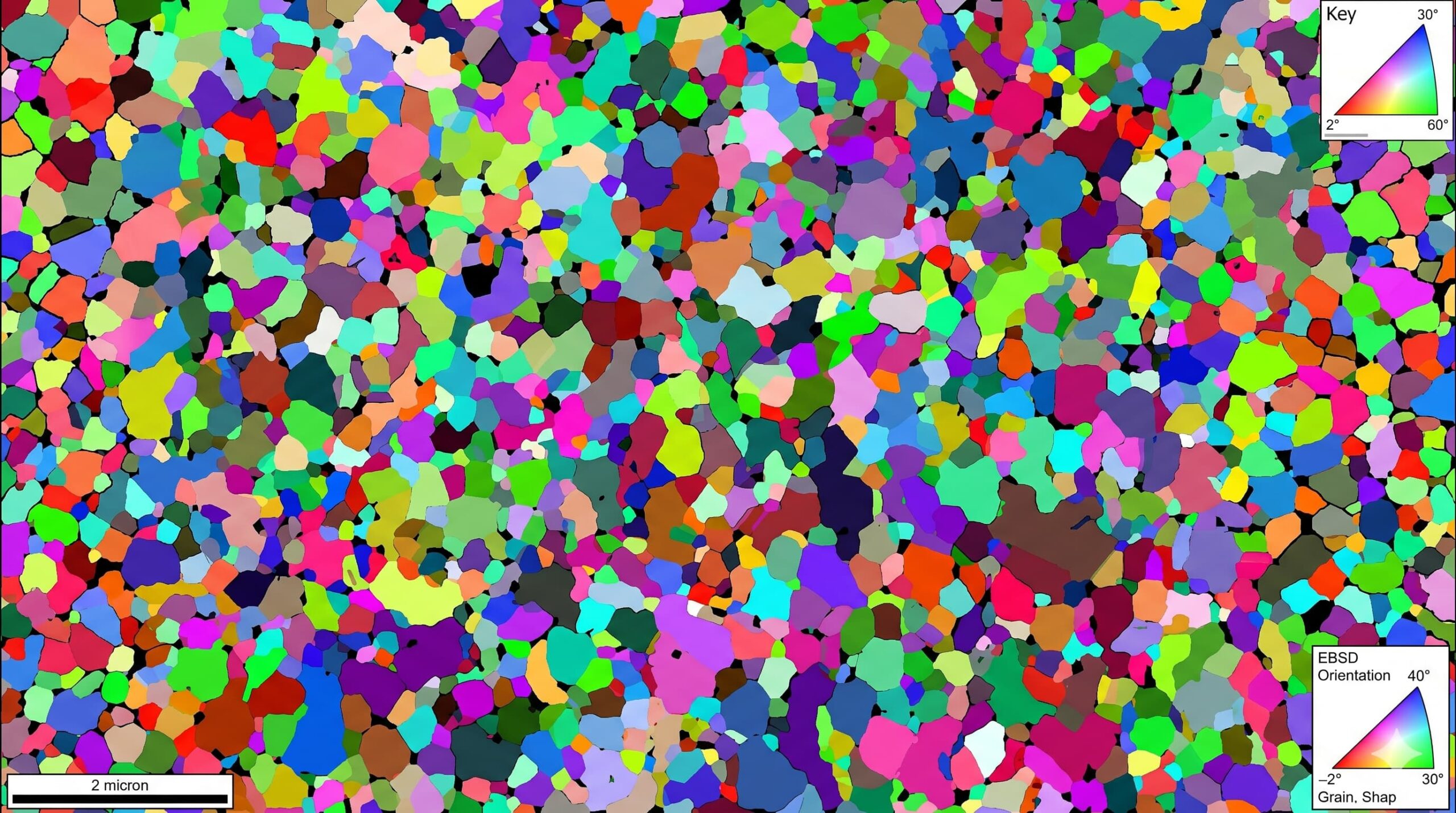
Most engineering materials are polycrystalline, meaning they are composed of an aggregate of many small crystals, or “grains.” Each grain is a localized region where the atomic lattice is oriented in a specific direction. The interfaces where these grains meet are known as grain boundaries.
These boundaries are regions of high interfacial energy and atomic disarray. From a scientific perspective, grain boundaries are critical because they act as impediments to dislocation motion—the primary mechanism of plastic deformation. According to the Hall-Petch relationship, reducing the average grain size increases the yield strength of a material. This phenomenon, known as grain-boundary strengthening, is a cornerstone of microstructural engineering. The morphology of these grains—whether they are equiaxed (uniform in all directions) or elongated (due to cold working)—provides a direct visual record of the strain history of the material.
Phase Transformations and Thermodynamic Equilibrium
A secondary, yet equally vital, component of microstructure is the presence of different phases. A phase is a physically distinct, chemically homogeneous portion of a system. In a dual-phase steel, for example, one might observe islands of hard martensite embedded within a soft, ductile ferrite matrix.
The formation of these phases is governed by the laws of thermodynamics, specifically the minimization of Gibbs free energy. However, the morphology of these phases—whether they appear as needles (acicular), plates (lamellar), or spheres (globular)—is dictated by the kinetics of transformation.
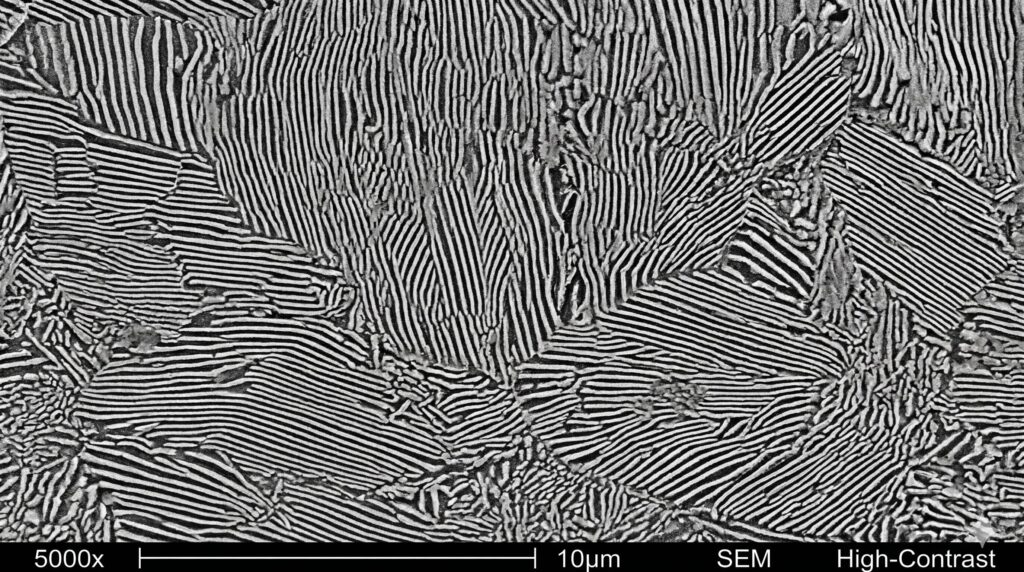
Consider the iron-carbon system:
- Pearlite: A lamellar (layered) microstructure formed by the slow, cooperative growth of ferrite and cementite.
- Martensite: A metastable, non-equilibrium phase formed via a diffusionless, displacive transformation.
- Bainite: A complex structure forming at intermediate cooling rates, characterized by plate-like ferrite and fine carbides.
Each of these microstructural constituents imparts a unique set of properties, and the ability to distinguish between them under a microscope is essential for failure analysis and quality assurance.
Defects: The Imperfect Perfection
Beyond grains and phases, the microstructure is populated by defects that operate on several length scales. Point defects (vacancies), line defects (dislocations), and planar defects (stacking faults) are invisible to optical microscopy but are the primary drivers of material behavior.
Inclusions—non-metallic particles trapped within the metallic matrix during the melting process—are also critical microstructural features. While often viewed as detrimental “impurities” that act as stress concentrators and crack initiation sites, some inclusions are intentionally engineered to control grain growth or improve machinability. The scientific characterization of inclusion cleanliness (e.g., oxides, sulfides, silicates) is a standardized procedure essential for high-integrity components.
Analytical Methodologies: Characterizing the Invisible
To reveal the microstructure, a material must undergo rigorous preparation. This involves sectioning, mounting, and a series of grinding and polishing steps to achieve a mirror-like finish. The subsequent step, chemical or electrolytic etching, is a controlled corrosion process. Because different phases and grain boundaries react at different rates to the etchant, they become visible under reflected light due to differences in topography and reflectivity.
While Optical Microscopy (OM) remains the standard for general characterization, the quest for higher resolution has led to the widespread use of:
- Scanning Electron Microscopy (SEM): Utilizing electrons instead of light to achieve magnifications up to 500,000x and offering immense depth of field.
- Transmission Electron Microscopy (TEM): Allowing scientists to observe individual dislocations and atomic lattices.
- Electron Backscatter Diffraction (EBSD): A technique used in the SEM to map the crystallographic orientation of grains, providing a quantitative “map” of the microstructure.
The Horizon of Microstructural Design
The future of materials science lies in the computational design of microstructure. With the advent of Integrated Computational Materials Engineering (ICME), scientists can now simulate how a microstructure will evolve during complex processes like 3D printing (Additive Manufacturing). In additive processes, the rapid, localized melting and solidification create unique hierarchical microstructures—characterized by sub-micron cellular structures—that are impossible to achieve via traditional casting or forging.
As we move toward the development of “high-entropy alloys” and “nanostructured materials,” the scientific community continues to push the boundaries of what is possible. By manipulating matter at the micro-scale, we are able to engineer materials with “unnatural” property combinations, such as high strength paired with high ductility.
Conclusion
In summary, the microstructure is not merely a static image; it is a dynamic record of a material’s thermodynamics, kinetics, and mechanical life. From the Hall-Petch strengthening of refined grains to the complex phase distributions in advanced high-strength steels, every feature of the microstructure tells a story of performance. For the scientist, mastering the hidden architecture of materials is the only way to unlock the next generation of technological innovation.


Leave a Reply