
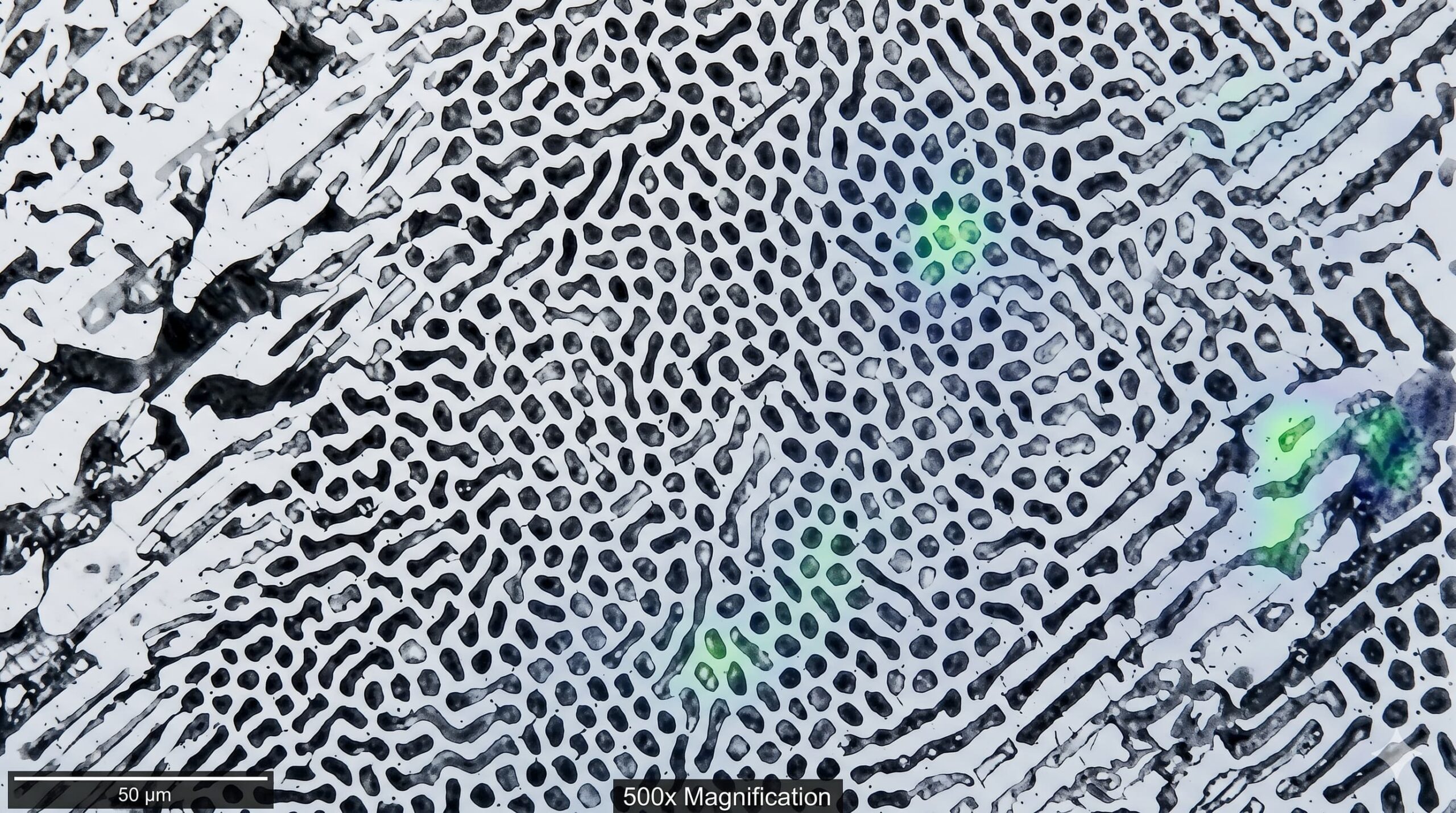
While many materials scientists spend their careers perfecting the balance of toughness and strength found in a tempered martensite microstructure, there is another side to the iron-carbon family that embraces extreme hardness and wear resistance above all else: White Cast Iron.
If gray iron is the reliable workhorse of the automotive industry, white cast iron is the hardened warrior of the mining and milling sectors. It is a material defined not by what it contains, but by what it lacks—specifically, free graphite. In this deep dive, we will explore the microscopic landscape of this brittle powerhouse, how it forms, and how modern AI tools are finally making its complex analysis a matter of seconds rather than hours.
The “White” Fracture: Why It’s Different
The name “White Cast Iron” doesn’t come from a coat of paint; it refers to the silvery, crystalline appearance of its fracture surface. Unlike gray iron, where the presence of graphite flakes absorbs light and creates a dull gray look, white iron is loaded with iron carbide (cementite).
During the cooling process, the carbon in white cast iron does not have the time or the chemical “permission” (usually due to low silicon content) to precipitate as graphite. Instead, it remains chemically bonded with iron as $Fe_3C$. The result is a material that is incredibly hard—often exceeding 60 HRC—but also as brittle as ceramic.
The Microscopic Landscape: Ledeburite and Dendrites
When you look at a white cast iron microstructure under a professional microscope viewer, you aren’t just looking at metal; you are looking at a frozen map of a violent solidification process. The primary features you will encounter are:
- Massive Cementite: This appears as large, bright white areas. Cementite is the hard, brittle phase that gives the iron its wear-resistant properties.
- Pearlite (or Martensite): Depending on the cooling rate and alloying elements, the areas between the cementite will consist of pearlite (a layered structure of ferrite and cementite) or, in high-performance alloys, martensite.
- Ledeburite: This is the “star of the show” in white iron. Ledeburite is a eutectic mixture of austenite and cementite. At room temperature, the austenite usually transforms into pearlite, but the characteristic “honeycomb” or “leopard-spot” pattern remains.
The morphology of these phases is dictated by the cooling rate. Fast cooling promotes a fine, inter-dendritic structure, while slower cooling allows for massive, coarse cementite plates that can significantly lower the material’s already precarious impact toughness.
Alloying for Performance: The Role of Chromium and Nickel
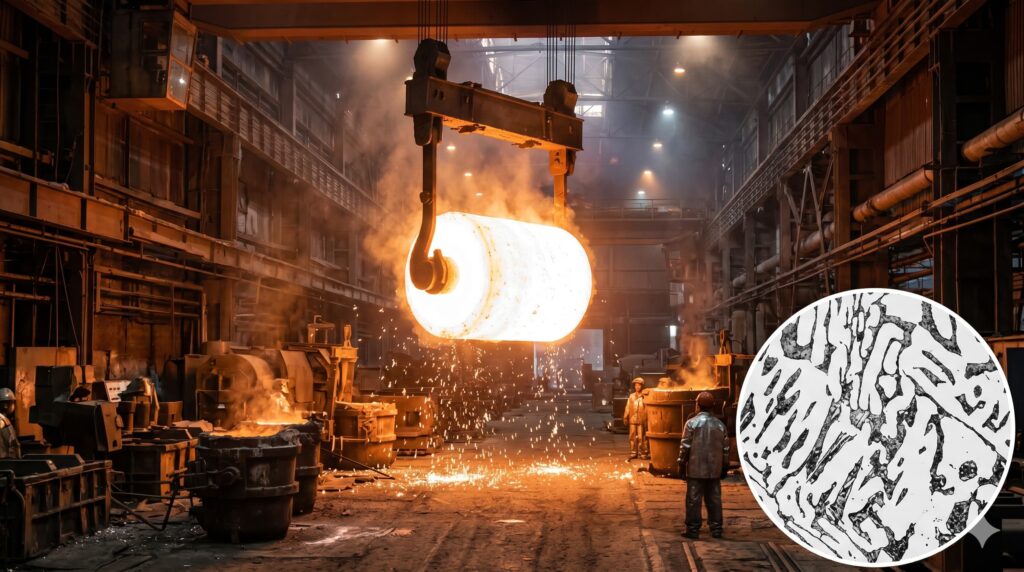
In 2026, we rarely see “plain” white cast iron in high-stress industrial applications. To enhance its properties, we add alloying elements. Chromium is the most common addition; it stabilizes the carbides and ensures that even at thicker cross-sections, the carbon remains as cementite rather than graphite.
Nickel-Hard (Ni-Hard) irons are another fascinating branch. By adding nickel and chromium, the matrix transforms into a structure that closely resembles a tempered martensite microstructure but is embedded with massive carbides. This creates a “composite” material that can withstand the brutal abrasion of grinding gold ore or crushing granite.
Preparation and Etching: The Metallographer’s Challenge
Because white cast iron is so hard, sample preparation is a test of patience. Standard silicon carbide papers often wear out instantly against the massive cementite plates.
- Pro Tip: Use diamond grinding discs to ensure the surface remains flat. If you use a soft polishing cloth for too long, you will create “relief” where the softer pearlite is eaten away faster than the hard carbides, making the image impossible to focus on.
For etching, 3% Nital is the go-to reagent. It provides excellent contrast by darkening the pearlite while leaving the cementite brilliantly white. However, if you are analyzing high-chromium white irons, you might need a more aggressive etchant like Vilella’s Reagent to reveal the grain boundaries within the complex carbide matrix.
AI-Powered Analysis: The MicroVision Suite Advantage
Analyzing a white cast iron microstructure manually is a nightmare for even the most experienced lab technician. Calculating the “Phase Fraction” (the ratio of cementite to the matrix) is critical for predicting how long a mill liner will last in the field. Doing this with traditional grid-counting methods is slow and highly subjective.
This is where the MicroVision Suite changes the game. By utilizing Deep Learning algorithms, the software can instantly distinguish between the bright cementite plates and the darker pearlitic matrix. It doesn’t get confused by polishing scratches or minor stains.
- One-Click ASTM Compliance: The software quantifies the phases, measures the dendritic spacing, and generates an audit-ready report in under 60 seconds. In an industry where “time is money,” moving from manual estimation to AI-driven precision is the single best upgrade a lab can make in 2026.
Conclusion: Why White Iron Still Matters
While modern engineering often favors the toughness of a tempered martensite microstructure, white cast iron remains irreplaceable in environments of extreme abrasion. It is a material that demands respect—not just for its hardness, but for the precision required to analyze it correctly.
By understanding the eutectic solidification of ledeburite and leveraging AI software like MicroVision Suite, metallurgists can ensure that these brittle giants perform their jobs without catastrophic failure. In the world of crushing and grinding, the white microstructure is still king.


Leave a Reply