
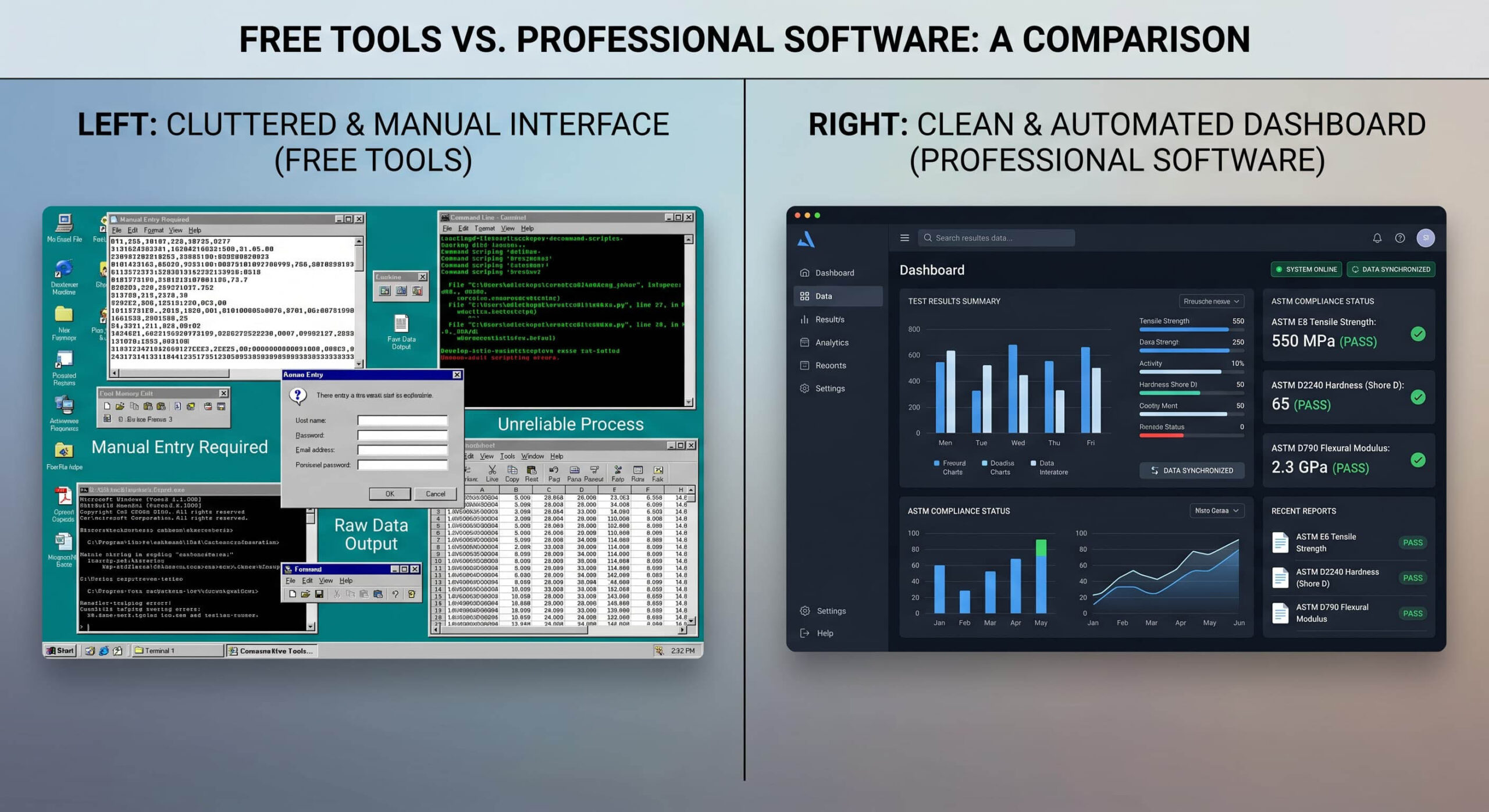
For industrial laboratories and materials science researchers, selecting the right image analysis software for microscopy is one of the most critical decisions of the decade. As we navigate 2026, the gap between open-source “hobbyist” tools and high-end professional suites has never been wider. While free tools offer a tempting entry point with zero upfront cost, professional solutions are designed to solve the high-stakes accuracy and compliance challenges found in modern search trends.
In this guide, we break down the reality of the “Free vs. Professional” debate to help you determine which path ensures your lab remains competitive and audit-ready.
The Allure of Free Tools: The ImageJ Legacy
For many, the journey into image analysis software for microscopy begins with open-source titans like ImageJ or Fiji. These platforms are the Swiss Army knives of the academic world. They are highly customizable, supported by a massive global community, and—most importantly—cost nothing to download.
However, in an industrial setting, “free” often comes with a hidden tax on your time. Open-source tools require a steep learning curve. If you need to perform specialized tasks like grain size analysis or inclusion rating, you often have to “build” the workflow yourself using various plugins. In a high-throughput lab where speed is a currency, spending hours calibrating a manual workflow can quickly negate any savings on software licensing.
The Professional Advantage: Precision Meets Automation
When you move to a professional image analysis software for microscopy, such as the Microvision Suite, you aren’t just buying an interface; you are investing in a validated industrial workflow.
1. Instant ASTM and ISO Compliance
Search data reveals a massive interest in ASTM E112 (grain size) and general microstructure analysis. Professional software has these standards “baked in.” Instead of manually drawing lines and counting intercepts—a process prone to human error—professional tools automate the measurement according to the latest regulatory revisions. When an auditor asks for your methodology, you can point to a standardized, software-validated report rather than a custom-made spreadsheet.
2. Handling the “Messy Reality” with AI
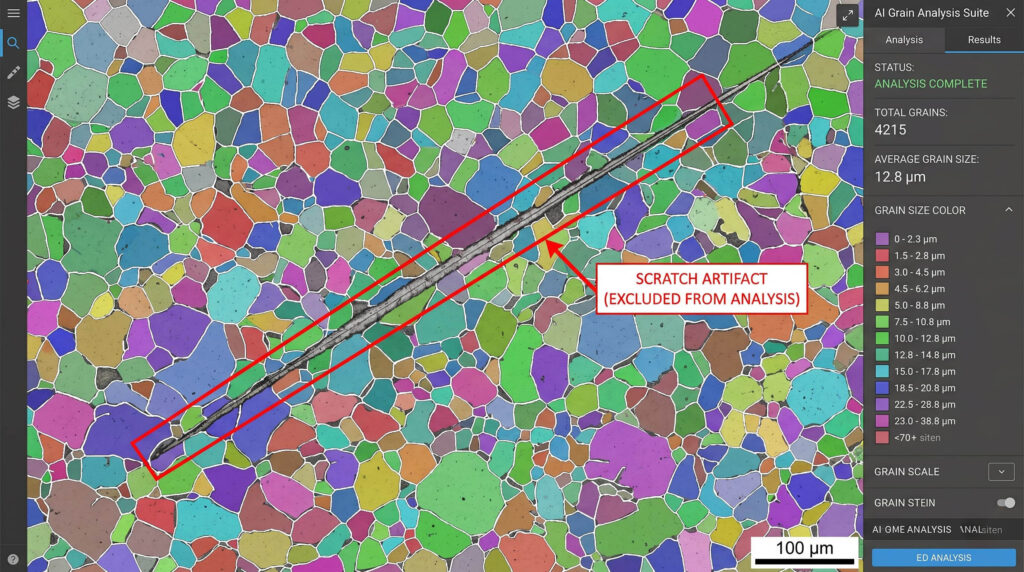
One of the biggest frustrations in microscopy is sample preparation artifacts—scratches, uneven etching, or dust. Free software is often “dumb” in this regard; it sees a scratch as a grain boundary. Professional suites now utilize Deep Learning and AI to understand context. They can distinguish between a true boundary and a polishing artifact, drastically reducing the “cleanup time” required after an analysis.
3. Solving Technical Bottlenecks
Data from Google Search Console shows that many professionals struggle with specific technical issues like Extended Depth of Field (EDF). While free tools might offer basic stacking, professional image analysis software for microscopy provides high-speed, real-time EDF and image stitching. This allows for the creation of high-resolution, perfectly sharp “maps” of large weld cross-sections or fracture surfaces in seconds.
The “Total Cost of Ownership” Calculation
To truly choose the best image analysis software for microscopy, you must look beyond the price tag and calculate the Total Cost of Ownership (TCO).
- Free Software: $0 License + 100 hours of setup + 15 minutes of manual reporting per sample.
- Professional Software: Licensing Fee + 2 hours of setup + 30 seconds of automated reporting per sample.
In a lab processing just 10 samples a day, the professional software typically pays for itself within the first three months through recovered man-hours alone.
When is it Time to Upgrade?
If your lab is experiencing any of the following, it is time to move beyond free tools:
- Audit Stress: You are worried about proving the repeatability of your manual measurements.
- High Volume: Your technicians are staying late to finish manual reporting.
- Low CTR on Quality: You have the visibility but lack the “sharpness” in your results to win over high-end clients.
Final Verdict
The best image analysis software for microscopy is the one that removes the “friction” between your sample and your final report. While free tools are excellent for education and basic research, industrial labs focused on ROI, accuracy, and ASTM compliance will find that professional suites like Microvision are the only way to ensure quality in 2026.
Leave a Reply