
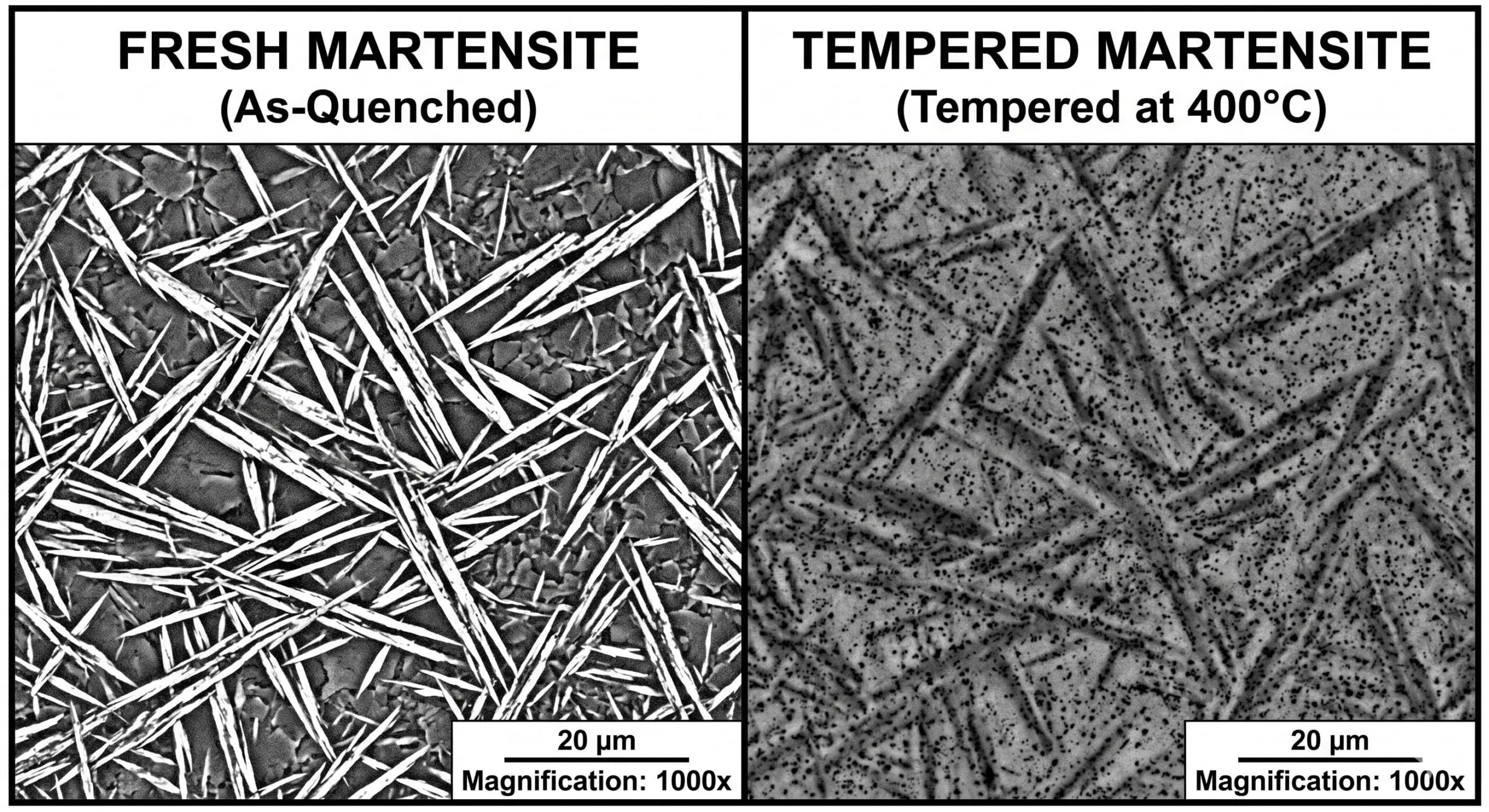
Understanding the tempered martensite microstructure is the cornerstone of modern metallurgy. In the relentless pursuit of materials that are both incredibly hard and remarkably tough, engineers have turned to one specific phase transformation more than any other. While raw martensite is the “strongman” of the steel world, it is also notoriously brittle—often as fragile as glass.
Tempering is the metallurgical redemption arc. It is the controlled process of reheating quenched steel to transform that brittle, stressed lattice into a balanced, high-performance structure. If you are a lab manager or a materials scientist in 2026, mastering the identification and analysis of this microstructure is vital for ensuring the structural integrity of everything from automotive gears to aerospace fasteners.
The Birth of the Beast: From Quenching to Stress
To understand the tempered martensite microstructure, we must first look at its predecessor: untempered (fresh) martensite. When steel is heated to its austenitic temperature and then rapidly “quenched” in water or oil, the carbon atoms are trapped in a sudden, violent freeze.
Instead of forming a relaxed cubic structure, the atoms are forced into a strained Body-Centered Tetragonal (BCT) lattice. This lattice is packed with internal stresses, making the steel exceptionally hard but prone to spontaneous cracking. In its untempered state, martensite is practically useless for industrial applications that involve impact or tension.
The Redemption: What Happens During Tempering?
Tempering is the act of providing just enough thermal energy (usually between 150°C and 700°C) to allow the trapped carbon atoms to diffuse out of the BCT structure. As the carbon escapes, the lattice “relaxes” back toward a more stable Body-Centered Cubic (BCC) form, and tiny, ultra-fine iron carbides (cementite) begin to precipitate.
As a metallographer, what you see through the lens changes drastically based on the tempering temperature:
- Low-Temperature Tempering (150-250°C): The acicular (needle-like) structure remains visible, but the needles begin to darken as the first stage of transition carbides form. Hardness remains high, but brittleness is significantly reduced.
- High-Temperature Tempering (Above 500°C): This is where we see the formation of “Sorbite.” The needles are replaced by a fine, granular distribution of carbides. This structure offers the best balance of ductility and strength.
Visualizing the Structure: Nital vs. Picral
Identifying a tempered martensite microstructure under a microscope is an art form that depends heavily on your choice of etchant.
- Nital (2-3%): This is the standard choice for most labs. It reveals the grain boundaries and provides a good general overview of the needle-like morphology.
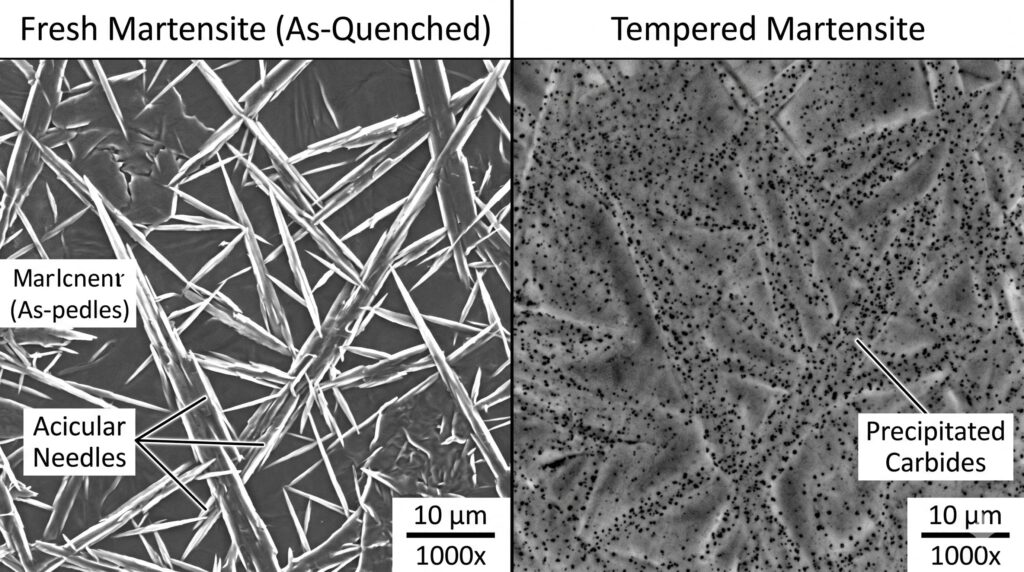
- Picral: If you are specifically looking for the fine distribution of carbides within the martensite, Picral is often superior. It provides better contrast for the precipitated phases without over-etching the grain boundaries.
The Challenge of 2026: AI Analysis of Fine Structures
One of the most significant hurdles in modern quality control is the subjective nature of identifying tempered states. Distinguishing between a slightly over-tempered and a correctly tempered structure can be difficult even for an experienced eye.
This is where AI-driven software like MicroVision Suite changes the game. Deep Learning algorithms are trained to recognize the “texture” of the tempered martensite. By analyzing the density and distribution of the precipitated carbides, the software can provide a quantitative assessment of the tempering quality. Instead of a technician guessing the state of the material, the AI provides a “Standard Deviation” of the structure, ensuring 100% repeatability in ASTM-compliant reports.
Why It Matters for Your Lab
The mechanical properties of a part—its yield strength, its fatigue life, and its impact energy—are all dictated by the nuances of the tempered martensite microstructure. A failure in the tempering furnace can lead to catastrophic field failures.
By mastering the preparation, etching, and digital analysis of this specific microstructure, you aren’t just looking at metal; you are ensuring safety. Whether you are performing a failure analysis or routine production QC, the story told by the martensitic needles and their carbide clusters is the most important story in the lab.


Leave a Reply